
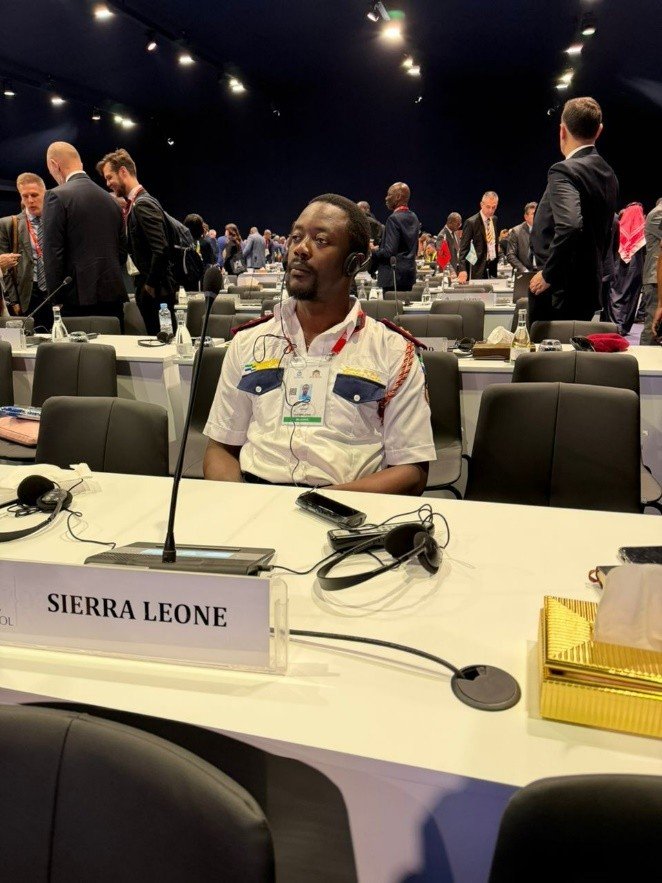
By Mackie M. Jalloh
The Executive Director of the Sierra Leone Road Safety Authority (SLRSA), James Bagie Bio, is in Marrakesh, Morocco, where he is participating in the 93rd INTERPOL General Assembly—an international gathering that brings together law enforcement leaders from across the world. His presence at this high-profile event signals Sierra Leone’s increasing commitment to global security cooperation, particularly in areas where road safety intersects with international crime prevention.
Held on Wednesday, 26 November 2025, the Marrakesh meeting convened hundreds of police chiefs, intelligence heads, and security-sector policymakers to deliberate on pressing security challenges. For Sierra Leone, the participation of the SLRSA and the Sierra Leone Police (SLP) delegation marks a new phase in its integration into global policing networks, especially at a time when transnational crime continues to evolve in complexity and scale.
SLRSA’s involvement is particularly strategic. Over the past months, the Authority has expanded its collaboration with the SLP to address a growing range of vehicle-related crimes—ranging from the trafficking of stolen vehicles across borders to the falsification of documents used to register such vehicles. Sierra Leone has increasingly found itself affected by international vehicle smuggling networks, prompting the SLRSA to tighten its national vehicle registration system and enhance back-end information verification procedures.
According to internal reports, the Authority has successfully blocked multiple attempted registrations of suspicious vehicles, a success owed in part to its closer engagement with regional and international crime databases. Director Bio’s participation in the INTERPOL Assembly is expected to further strengthen these operational linkages and open new pathways for real-time data sharing.
In Marrakesh, ED Bio is expected to engage in discussions around transnational organized crime, counter-terrorism measures, border security, cyber-enabled criminal activities, and the emerging use of technology in policing. His role at the event aligns with Sierra Leone’s broader objective of enhancing cooperation on matters related to vehicle identification systems, traffic crime investigations, and digital registration tools—areas where the SLRSA is continuously reforming.
The opening ceremony featured remarks from INTERPOL President Ahmed Naser Al-Raisi, who welcomed delegates from the 195 member countries. He praised the Kingdom of Morocco for hosting the Assembly and emphasized that the global security landscape is becoming more unpredictable, with cybercrime, terrorism, human trafficking, and transnational fraud now posing universal threats. He reminded participants that no region—big or small—is insulated from such challenges, and this makes coordinated action indispensable.
One of the major announcements at the Assembly was the unveiling of INTERPOL’s new strategic framework. This framework, developed through extensive consultations with member states, outlines four key strategic goals that give practical shape to INTERPOL’s vision, “Together against crime,” and its mission to connect and empower global law enforcement for a safer world. These goals aim to modernize policing tools, build stronger networks among global agencies, enhance intelligence-sharing platforms, and promote joint operations capable of tackling increasingly sophisticated criminal syndicates.
Throughout the week-long meeting, delegates will discuss how to strengthen cross-border intelligence systems, adapt to new forms of digital crime, and improve the interoperability of national policing databases. The Assembly will also vote to elect a new INTERPOL President and members of the Executive Committee, a process closely watched by participating nations due to its influence on future global security priorities.
For Sierra Leone, the presence of the SLRSA at such a critical meeting underscores a broader recognition: road safety is no longer limited to preventing crashes or enforcing traffic laws—it has become an essential component of national and international security. Stolen vehicles often serve as tools in bigger criminal operations, including smuggling, terrorism, and armed robbery. Strengthening vehicle registration integrity and aligning national systems with global databases is, therefore, a crucial step in combating organized crime.
As the Assembly continues, Director James Bio is expected to hold bilateral engagements with partner countries, explore technological innovations in traffic crime detection, and advocate for stronger support mechanisms to help developing nations like Sierra Leone modernize their security infrastructure.