By Mackie M. Jalloh
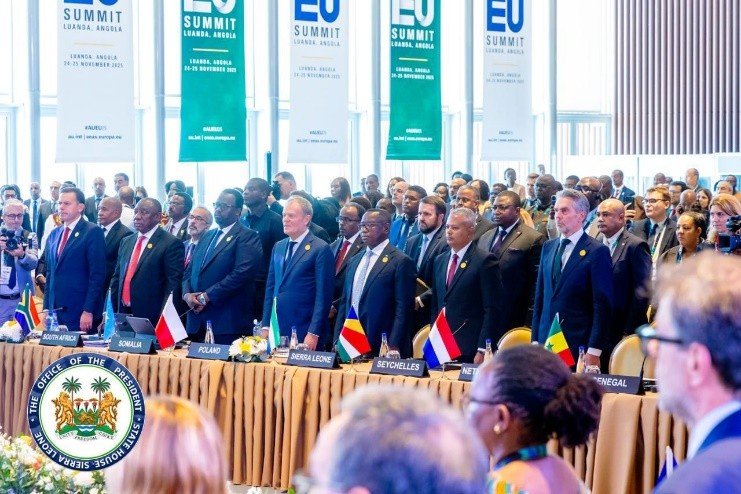
At the 7th African Union–European Union Summit held in Luanda, Angola, President Julius Maada Bio of Sierra Leone delivered a forceful message that resonated far beyond the conference hall: Africa is ready to renegotiate its place in the global system—and this time on its own terms. The President, who also serves as Chair of the ECOWAS Authority of Heads of State and Government, reframed the Summit’s agenda, shifting the conversation from traditional diplomacy to a broader demand for structural fairness, global cooperation, and shared accountability.
Rather than adopting the familiar rhetoric of partnership, President Bio presented a clear departure from the conventional narrative that has long governed Africa–Europe relations. His speech challenged entrenched power imbalances and called for a transformation of international engagement grounded in equality, dignity, and reciprocity—not charity or conditional alliances.
Addressing African and European leaders, President Bio acknowledged the warm hospitality of the Angolan government but quickly pivoted to the urgent realities confronting the global community. He warned that the world’s interconnectedness has not translated into stability, noting instead that vulnerability and distrust have deepened between regions. The global system, he argued, is no longer fit for purpose.
But the President did not limit his intervention to a critique of global fragility. He pressed for concrete shifts in how Africa is perceived and engaged, especially in matters of governance, security, and economic transformation. He highlighted the continent’s steady—but often understated—progress in democratic processes, insisting that Africa is not defined by coups or crises but by its resilience and determination to chart a better path forward.
In a pointed reflection on West Africa, President Bio reaffirmed ECOWAS’ uncompromising stance against unconstitutional changes of government. He asserted that stability cannot be sustained by sanctions alone; it requires social contracts rooted in public trust, credible transitions, and citizens’ confidence in state institutions. Only then, he argued, can governance be durable and democratic.
He then expanded the conversation to security—a theme that continues to dominate Africa’s geopolitical landscape. The President underscored the alarming rise of terrorism and violent extremism, noting that Africa recorded the highest number of terrorism-related deaths globally last year. But he refused to accept the framing of Africa as merely a battleground for global threats. Instead, he reminded the Summit that Sierra Leone has used its seat on the UN Security Council to elevate issues that many major powers often sideline: small arms proliferation, conflict-induced hunger, and the reinforcing link between insecurity and economic deprivation.
In one of the most compelling sections of his statement, President Bio argued that peace cannot be engineered solely through military might. He called for an approach grounded in economic opportunity, justice, inclusion, and strong state–citizen relations—components he described as the true foundation of national security.
As Coordinator of the African Union Committee of Ten (C-10) on UN Security Council Reform, President Bio used the platform to challenge the legitimacy of the current global governance architecture. His message was unapologetic: Africa does not seek benevolence but justice. The structure of the Security Council, he said, is a relic of colonial imbalance and must be corrected if global governance is to be fair, credible, and representative. “The reform of the Security Council is not a favour to Africa,” he insisted. “It is a long-overdue correction to history.”
Turning to development priorities, President Bio called for a shift from rhetorical promises to genuine impact. Africa, he argued, is prepared for climate resilience, industrialisation, digital advancement, and energy transition—but these ambitions require partnerships that do not exploit or patronize. He called for predictable financing frameworks, especially for African Union-led peace support operations, referencing Sierra Leone’s backing of UN Security Council Resolution 2719. However, he cautioned that financing without structural transformation would do little to alter the continent’s long-term trajectory.
Closing his address, President Bio emphasized that Africa is not begging for help. It is demanding respect, dignity, and fairness in every global engagement. He urged leaders at the Summit to embrace a future where cooperation supersedes competition, and where partnership is defined not by dominance but by shared humanity.
“Africa is ready for the world,” he said. “The question is whether the world is ready for an Africa that stands tall, speaks boldly, and demands equality.”