By Mackie M. Jalloh
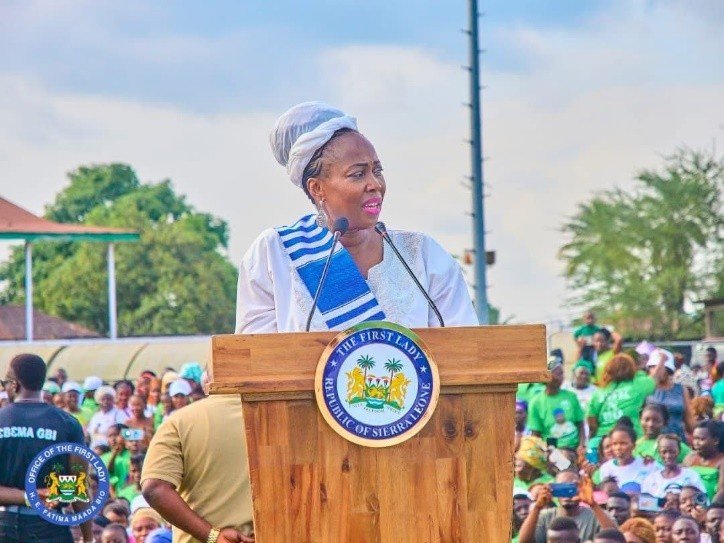
The fight against drug abuse in Sierra Leone gained renewed momentum on Monday, 24th November 2025, as Her Excellency Dr. Fatima Maada Bio, First Lady of Sierra Leone and President of the Organization of African First Ladies for Development (OAFLAD), led a powerful community mobilisation effort in Bo District. But unlike previous anti-drug initiatives that focused mainly on urban sensitisation, this latest campaign took a more grassroots, community-driven direction—anchored in faith leadership, local accountability, and collective action.
The campaign, branded “Say No to Kush,” was spearheaded by the United Council of Imams Sierra Leone (UCI-SL), Southern Region, whose clerics have increasingly voiced concern over the moral, social, and spiritual damage caused by the synthetic drug ravaging the country’s youth. The decision by religious leaders to take the lead marks a significant shift in the national approach to drug prevention, recognising that sermons, mosques, and community moral structures remain some of the most influential platforms in Sierra Leone’s social fabric.
The First Lady’s presence brought national attention to the initiative, but her role went beyond mere symbolism. She emphasised that the war against Kush can no longer be left to the government or law enforcement alone—it requires families, faith communities, educators, traditional leaders, and local influencers to unite against an epidemic that has quietly destroyed potential, broken homes, and undermined the dignity of young people.
Addressing the thousands who gathered, Dr. Fatima Maada Bio spoke with a renewed sense of urgency. She stressed that addiction is not a moral failure but a social crisis that demands compassion, education, and structured rehabilitation. She criticized the growing culture of silence that allows communities to watch young people sink into addiction without intervention. “Kush is stealing futures,” she warned, “but our silence and indifference are helping it win.”
Unlike earlier national campaigns, which largely centred on public marches and high-level statements, this Bo District launch prioritized community conversations: parents shared stories of how addiction had shattered their households; youth representatives admitted the pressures and frustrations that drive young people toward harmful substances; and imams offered guidance rooted in both faith and lived realities.
By grounding the campaign in faith-based leadership, UCI-SL signalled that the crisis requires a moral and spiritual awakening as much as legal and medical solutions. Religious leaders committed to integrating anti-drug messages into their weekly sermons, while also pledging direct support for families struggling with addicted youth—something many parents have long felt they lacked.
The First Lady highlighted the importance of creating new opportunities for young people, particularly in districts like Bo that serve as educational and economic hubs for the south and beyond. She argued that youth empowerment must go hand in hand with anti-drug advocacy. “If we want young people to say no to drugs, then society must give them something meaningful to say yes to,” she noted, calling for expanded skills programmes, mentorship networks, and emotional support systems.
Observers say the campaign’s new dynamics—faith leadership, community testimony, and First Lady-led mobilisation—represent a more holistic approach to Sierra Leone’s drug crisis. The hope is that by reshaping the narrative and focusing on healing rather than punishment, the country can break the cycle of addiction that has trapped thousands of young people.
The Bo gathering ended with a renewed pledge from both religious leaders and residents: that communities will no longer treat drug abuse as a distant or shameful issue, but as a collective responsibility demanding unity, courage, and compassion.
With this campaign, Sierra Leone signals a new chapter—one where the fight against Kush is not just a national policy, but a people’s movement.