Lahai Sets New Standard at NAYCOM
By Mackie M. Jalloh
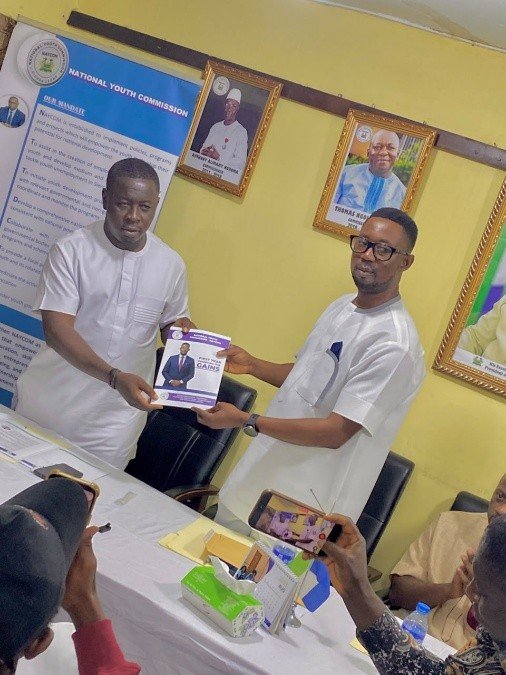
The National Youth Commission (NAYCOM) has highlighted a year of remarkable institutional reforms, youth empowerment and strategic growth under the leadership of Commissioner Joseph Maada Lahai, as the Commission presented its One Year Transformational Leadership Gains Report during a press briefing in Freetown.
Addressing journalists, Commissioner Lahai said the briefing was intended to account for his stewardship since assuming office on August 6, 2025, following his appointment by President Julius Maada Bio. He noted that the past year has been dedicated to transforming NAYCOM into a stronger and more responsive institution capable of unlocking the potential of Sierra Leone’s young people.
Guided by the vision of “Transforming Youth Potential into National Prosperity,” Lahai said his administration has prioritised institutional discipline, youth empowerment and strategic partnerships to deliver meaningful opportunities for young people across the country.
One of the Commissioner’s first achievements, he explained, was restoring discipline within the institution. He disclosed that approximately 98 percent of NAYCOM staff now report to work on time and leave at the appropriate time, reflecting a renewed culture of professionalism, accountability and commitment to public service.
Recognising that strong institutions are essential to sustainable youth development, Lahai said his administration established three new directorates to improve efficiency, strengthen service delivery and reposition the Commission to better respond to the needs of Sierra Leone’s youthful population.
He also announced the ongoing rehabilitation of the Obasanjo Skills Training College, describing the institution as a critical investment in building a skilled workforce capable of driving national development. According to him, the rehabilitation project will provide thousands of young people with practical and technical skills required for employment and entrepreneurship.
The Commissioner further disclosed that over 4,000 young people have already acquired skills out of a targeted 8,000 beneficiaries, demonstrating the Commission’s determination to expand access to technical and vocational education.
He noted that TVET scholarships are no longer concentrated in urban centres but have been extended to young people in rural communities, ensuring that opportunities for skills development are distributed more equitably across the country.
Among the Commission’s flagship initiatives are two landmark projects aimed at strengthening youth capacity and expanding employment prospects. These include programmes focused on equipping young Sierra Leoneans with maritime skills and the continued rehabilitation of the Obasanjo Skills Training College to prepare more youths for the labour market.
Lahai emphasised that youth development cannot be achieved in isolation and therefore appealed for stronger collaboration with development partners, including the International Organization for Migration (IOM) and Leone Rock Metal Group, as well as other institutions committed to supporting youth empowerment.
He also highlighted the development of the National Youth Strategic Plan, describing it as a product of extensive consultations involving former NAYCOM Commissioners whose contributions helped shape the Commission’s long term vision.
According to him, the strategic plan provides a comprehensive roadmap for institutional development, digital transformation, TVET expansion and the establishment of safer migration mechanisms for young people seeking opportunities abroad.
As he concluded his address, Commissioner Lahai made a passionate appeal to development partners, law enforcement agencies and other stakeholders to view commercial motorbike and tricycle riders as productive young citizens rather than criminals.
He urged authorities to create opportunities that would integrate them into national development instead of resorting to incarceration, while also advising young people to reject drug abuse and embrace education, entrepreneurship and skills acquisition.
The Commissioner expressed profound gratitude to President Julius Maada Bio and the Ministry of Youth Affairs for their unwavering support, which he said has enabled the Commission to implement key reforms during his first year in office.
Board Chairman Saidu Alie Lakoh commended Commissioner Lahai and the entire NAYCOM staff for their dedication and relentless efforts in advancing the youth development agenda. He praised the Commissioner’s leadership, describing it as visionary and transformative.
Director of Monitoring and Evaluation, Yusuf S. Kamara, presented details of the Commission’s Strategic Plan, which is built around five thematic pillars: Organisational and Institutional Development, Youth Employment and Employability, Youth Civic Engagement, Governance and Technology, Partnership and Revenue Mobilisation, and Health, Well being and Civic Education.
Despite challenges such as limited financial resources, increasing demand for employment opportunities, fragmented labour market information and evolving development priorities, Kamara said NAYCOM has continued to make significant progress.
He revealed that between August 2025 and August 2026, the Commission expanded its TVET and employability programmes, with 1,300 youths certified in vocational and digital skills, including 749 young people trained specifically in digital skills.
Additionally, the Commission supported approximately 4,100 youth-led small and medium-sized enterprises (SMEs) in Bo, Makeni and Freetown, providing opportunities for entrepreneurship, job creation and economic empowerment.
The presentation of the One Year Leadership Gains Report painted the picture of a Commission undergoing meaningful transformation under Commissioner Joseph Maada Lahai. Through institutional reforms, expanded skills development, digital innovation and stronger partnerships, NAYCOM has demonstrated a renewed commitment to empowering Sierra Leone’s youth and positioning them as key drivers of national development.
As the Commission enters its second year, expectations remain high that the momentum created under Lahai’s leadership will continue to deliver greater opportunities, stronger institutions and a brighter future for the young people of Sierra Leone.