
By Mackie M. Jalloh
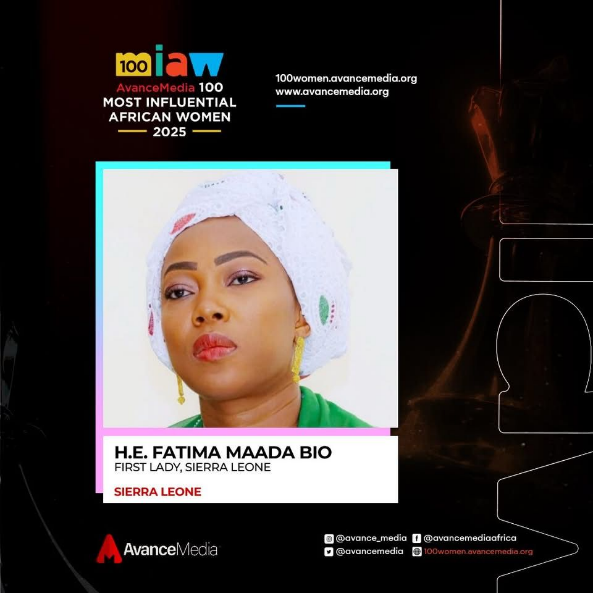
The First Lady of the Republic of Sierra Leone and President of the Organisation of African First Ladies for Development (OAFLAD), Her Excellency Dr. Fatima Maada Bio, has been named among the 100 Most Influential Women in Africa, an honour that reflects her growing continental impact and unwavering commitment to women’s empowerment, social justice, and human development.
The recognition has been widely welcomed across Sierra Leone and beyond as a testament to Dr. Fatima Bio’s leadership, advocacy, and transformative work for women and girls. In responding to the honour, the First Lady expressed deep gratitude and humility, acknowledging that the recognition is not solely a personal achievement but a reflection of collective effort, faith, and national support.
Dr. Fatima Bio described the honour as “profound,” emphasizing that it is only by the grace of Allah and the unwavering support of the people of Sierra Leone—fondly referred to as Mama Salone—that such recognition is possible. She noted that the journey of service is anchored in purpose, compassion, and a deep sense of responsibility to those whose voices often go unheard.
Far from viewing the recognition as a destination, the First Lady said she receives it as a renewed call to service. She reaffirmed her commitment to continue championing the rights, dignity, and empowerment of women and girls, not only in Sierra Leone but across Africa. According to her, influence must translate into impact, and recognition must be matched by sustained action.
Since assuming the role of First Lady, Dr. Fatima Maada Bio has emerged as one of Africa’s most vocal advocates against sexual and gender-based violence, child marriage, and harmful traditional practices. Her leadership has been instrumental in elevating conversations around women’s rights from the margins to the centre of national policy discourse in Sierra Leone. Through persistent advocacy, she has helped drive legal reforms, public awareness campaigns, and survivor-centred interventions aimed at protecting vulnerable populations.
At the continental level, her presidency of OAFLAD has further amplified her influence. Under her leadership, the organisation has pursued coordinated action among African First Ladies to address pressing development challenges affecting women and children. These include access to education, sexual and reproductive health, economic empowerment, and the fight against gender-based violence. Her role has positioned her as a unifying voice, advocating for policy alignment and shared accountability across African nations.
Dr. Fatima Bio’s work has consistently emphasized that empowering women and girls is not a symbolic gesture but a strategic imperative for sustainable development. She has often stressed that societies cannot thrive when half of their population is excluded, silenced, or left vulnerable. This philosophy has guided her initiatives and shaped her engagements at local, regional, and international platforms.
The recognition as one of Africa’s 100 Most Influential Women also reflects her ability to connect advocacy with lived realities. Her approach combines policy engagement with grassroots impact, ensuring that programs and reforms respond to real needs. From supporting survivors of abuse to promoting girls’ education and leadership, her work has touched lives in tangible ways.
As tributes continue to pour in, the First Lady has maintained a tone of humility, reiterating that her influence is rooted in service rather than status. She has called on women and girls to believe in their worth and potential, while urging institutions and leaders to create enabling environments where women can thrive.
In receiving this honour, Dr. Fatima Maada Bio stands not only as a representative of Sierra Leone but as a symbol of African women’s resilience, leadership, and transformative power. With renewed purpose, she has reaffirmed her resolve to continue serving humanity with compassion, courage, and conviction—ensuring that influence is measured not by recognition, but by lasting change.