
By Mariama Bundu
In a world increasingly shaped by climate shocks, conflict, and social inequality, the role of women is no longer confined to survival it is defined by leadership, endurance, and transformation. Across Africa, women continue to stand at the frontline of crises, not as victims, but as architects of resilience. It is within this evolving narrative that Sierra Leone’s First Lady, Fatima Maada Bio, has intensified her continental advocacy, positioning women and girls at the center of sustainable development and recovery.
Her recent engagements in Gabon signal a strategic shift from rhetoric to action, as African First Ladies consolidate their influence to address the intersection of climate change, conflict, and gender inequality. At the heart of this effort is the launch of the #BuildingResilience campaign an initiative designed to empower women and girls to withstand and overcome the growing pressures posed by environmental and socio political instability.
Rather than framing women as passive recipients of aid, the campaign boldly redefines them as critical agents of change. It underscores a reality often ignored in policy conversations: women, particularly in vulnerable communities, are already leading adaptation efforts, sustaining households, and rebuilding societies in the aftermath of crises. What they require is not sympathy, but structured support, recognition, and investment.
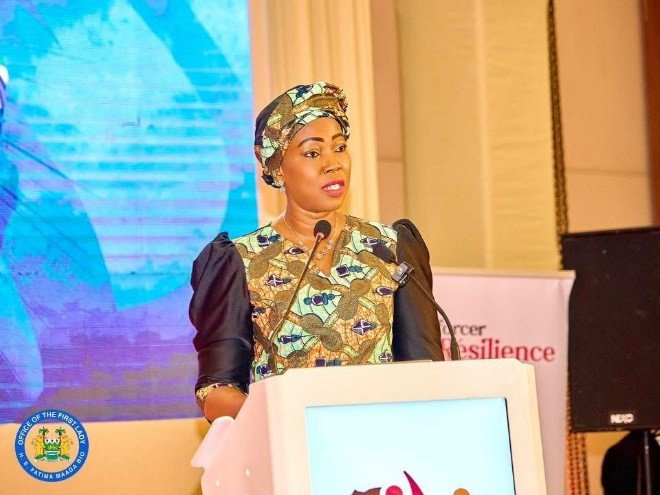
Speaking during the launch, Fatima Bio emphasized a message that cuts through long-standing stereotypes. Women and girls, she asserted, are neither weak nor helpless. They are resilient, capable, and consistently rising even in the face of overwhelming adversity. This framing is not merely symbolic; it challenges deeply entrenched societal attitudes that continue to limit opportunities for women across the continent.
Her presence alongside Zita Oligui Nguema and other African First Ladies also highlighted the growing importance of regional solidarity in tackling shared challenges. The gathering was not just ceremonial it functioned as a high-level platform for aligning strategies, pooling influence, and reinforcing commitments to gender equality and social protection.
Beyond policy discussions, the visit incorporated a cultural dimension that revealed another layer of advocacy often overlooked in development discourse. A guided tour of Gabon’s cultural showcase offered a vivid reminder that Africa’s progress must not come at the expense of its identity. For Fatima Bio, the experience reinforced a critical principle: sustainable development must be rooted in cultural preservation. Traditions, art, and heritage are not relics of the past they are foundational elements that shape resilient societies.
This perspective introduces a more holistic approach to empowerment one that integrates economic, social, and cultural dimensions. It suggests that strengthening women’s resilience is not only about financial inclusion or access to resources, but also about affirming identity, dignity, and belonging.
The diplomatic engagements continued with a high level dinner hosted by Zita Oligui Nguema, bringing together influential First Ladies under a shared agenda. These interactions, often underestimated, play a crucial role in advancing soft diplomacy. They create informal yet powerful spaces where ideas are exchanged, alliances are formed, and commitments are translated into actionable frameworks.
For Fatima Bio, such platforms are not endpoints but catalysts. Her emphasis remains on ensuring that these high-level discussions produce tangible outcomes for women and children in Sierra Leone and beyond. As President of the Organisation of African First Ladies for Development, her mandate extends beyond national borders, requiring her to navigate complex regional dynamics while maintaining a clear focus on impact.
What emerges from this series of engagements is a calculated and deliberate advocacy strategy one that leverages visibility, partnerships, and influence to push forward an agenda that is both urgent and transformative. It reflects a broader shift in how African leadership is approaching gender issues: moving away from isolated interventions toward integrated, continent-wide solutions.
In a time when global crises disproportionately affect women and girls, initiatives like #BuildingResilience are not optional they are essential. And through her continued engagement, Fatima Bio is making it clear that resilience is not just a concept to be discussed in conference rooms; it is a lived reality that must be supported, amplified, and sustained.
Her message resonates beyond speeches and events. It is a call to action one that demands accountability from governments, institutions, and communities alike. Because if Africa is to navigate the complexities of climate change and conflict, it will do so on the strength of its women.