
By Mackie M. Jalloh
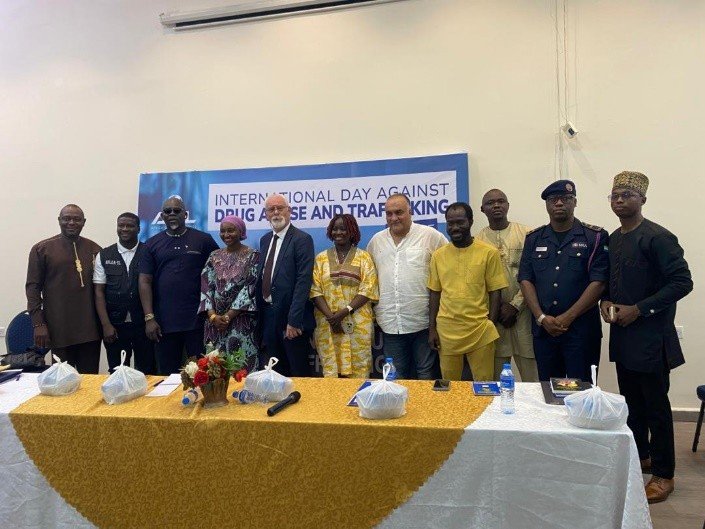
A strong call for collective responsibility, prevention, and vigilance against drug abuse and illicit trafficking dominated this year’s commemoration of the International Day Against Drug Abuse and Illicit Trafficking, as Africa Global Logistics (AGL), through its subsidiary Freedom Terminal Limited, brought together government officials, security agencies, port stakeholders, and members of the public at the New Brookfields Hotel in Freetown.
Held under the global theme, “The World Drug Problem: Past Challenges, New Threats, and Innovative Responses,” the event served as a platform for participants to reaffirm their commitment to creating drug-free workplaces, strengthening institutional collaboration, and protecting Sierra Leone’s youth from the devastating effects of illicit drugs.
Welcoming participants, Abibu Jalloh expressed appreciation to representatives from government ministries, security institutions, development partners, the private sector, and civil society for honouring the occasion, describing their presence as evidence of a shared determination to combat one of society’s most pressing challenges.
Delivering the first keynote presentation on behalf of Freedom Terminal Limited, Patrick Sannoh underscored the importance of maintaining a drug free working environment, particularly within the country’s ports and logistics sector, where safety and security remain paramount.
He said the nature of port operations requires every employee, contractor, and stakeholder to remain alert, responsible, and free from the influence of illegal substances.
“Our operations demand sound judgment, teamwork, and discipline. Safety is not simply one of our priorities it is the foundation upon which everything we do depends,” he stated.
Sannoh reiterated that Freedom Terminal Limited operates under a strict Zero Tolerance Drug Policy, which prohibits the possession, use, distribution, trafficking, or sale of illegal drugs within company premises or during official duties.
He stressed that violations of the policy attract serious disciplinary measures, including dismissal and referral to law enforcement authorities where necessary.
Recognising that ports and border crossings are frequently targeted by international drug trafficking networks, he urged employees and stakeholders to remain vigilant and promptly report suspicious behaviour, unusual cargo movements, unauthorised access, or breaches of security procedures.
According to him, awareness, personal responsibility, and mutual support remain the strongest tools in preventing drug abuse and criminal infiltration within the workplace.
He also encouraged employees to support colleagues experiencing substance abuse challenges by directing them towards appropriate rehabilitation and counselling services rather than isolating them.
Addressing the gathering, AGL Country Manager Captain Fabjanko Kokan described drug trafficking as one of the greatest threats facing modern societies, warning that its consequences extend far beyond individual users.
He said illicit drugs continue to destroy families, fuel organised crime, encourage corruption, increase violence, and rob young people of opportunities for productive lives.
“Drug trafficking is not a victimless crime,” Captain Kokan said. “It destroys dreams, separates families, weakens communities, and places enormous pressure on national institutions.”
He maintained that while traffickers pursue financial gain, there are values that money can never purchase.
“Money cannot buy integrity. It cannot buy dignity. It cannot buy humanity. These are the values that define us as individuals and as a society.”
Captain Kokan emphasised that education remains one of the most effective long-term investments in preventing drug abuse.
Recalling his recent support for the construction of a school in a rural community, he said providing quality education gives young people opportunities to develop skills, secure employment, and resist criminal influences.
“This responsibility extends beyond my position as Country Manager,” he remarked. “It is my responsibility as a father, as a grandfather, and as a citizen who wants to see future generations protected.”
He further called on all stakeholders within the maritime and logistics industry to work together, stressing that ports serve as strategic gateways for international trade but are also attractive targets for organised criminal networks involved in drug trafficking.
According to him, protecting the country’s ports requires teamwork, mutual respect, professionalism, and cooperation among all institutions responsible for border security.
Representing the National Drug Law Enforcement Agency (NDLEA), the Director of Drug Prevention, Education and Training delivered the keynote address on behalf of the Executive Director General.
He observed that while significant progress has been made globally in combating illicit drugs, criminal organisations continue to adopt increasingly sophisticated methods by exploiting technology, weak institutions, vulnerable populations, and international trade routes.
He outlined four strategic pillars guiding the Agency’s national response.
The first, he explained, is prevention through strong family structures, emphasising that parents remain the first line of defence against drug abuse by instilling discipline, integrity, and positive values in children.
The second pillar focuses on balancing compassion with firm law enforcement.
He urged society to show empathy towards individuals battling substance dependence while maintaining zero tolerance towards traffickers, manufacturers, financiers, and criminal syndicates responsible for distributing illegal drugs.
He noted that people suffering from addiction require treatment, rehabilitation, and social support rather than discrimination.
The third pillar centres on rehabilitation and reintegration.
According to the NDLEA representative, rehabilitation programmes continue to expand through partnerships with psychiatric facilities, social welfare institutions, and other government agencies aimed at helping recovering addicts rebuild their lives through vocational training and community reintegration.
He appealed to communities to accept rehabilitated individuals without stigma, noting that successful recovery depends largely on family and community support.
The fourth pillar focuses on intelligence led law enforcement.
He disclosed that the Agency continues to strengthen investigations, border security, and collaboration with both national and international partners in disrupting organised drug trafficking networks.
He also highlighted the Agency’s commitment to transparency through the public destruction of confiscated narcotics witnessed by representatives from the media, civil society, religious organisations, and government institutions to assure citizens that seized drugs are not reintroduced into circulation.
The official further revealed that from January to April 2026, the Agency secured more than 48 convictions in drug-related cases, describing the achievement as evidence of its determination to enforce the law while strengthening prevention and public education.
Throughout the event, speakers consistently stressed that the fight against drug abuse cannot be left solely to security institutions.
Instead, they called for stronger partnerships involving government, the private sector, educational institutions, parents, religious organisations, communities, and individual citizens.
Participants agreed that creating drug free workplaces, investing in youth education, strengthening family values, supporting rehabilitation, and promoting public awareness are essential components of a comprehensive national response.
The commemoration concluded with a vote of thanks delivered by Ajuah Daramy, who expressed appreciation to all participants for their commitment and urged stakeholders to sustain the momentum generated during the event by continuing to work together towards building safer communities and protecting future generations from the dangers of drug abuse and illicit trafficking.