
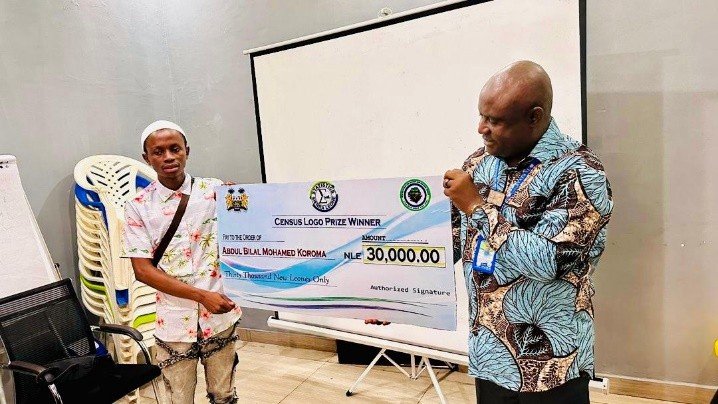
Statistics Sierra Leone (Stats SL) has formally presented a cash prize of NLe 30,000 to Abdul Bilal Mohamed Koroma, the winner of the 2026 Population and Housing Census Logo Competition, marking a significant milestone in the country’s preparations for the forthcoming national census. The cheque presentation took place during a media briefing on 16 January 2026 at the Stats SL Headquarters, located on King Street, Kona Lodge, Freetown.
The award ceremony brought together senior officials of Statistics Sierra Leone, members of the media, and invited guests, underscoring the institution’s commitment to transparency and public engagement as it intensifies preparations for one of the most critical national exercises. The logo competition, which attracted submissions from across the country, was designed to foster nationwide participation, encourage creativity, and create a sense of ownership among citizens ahead of the 2026 Population and Housing Census.
According to Stats SL officials, the initiative forms part of a broader strategy to ensure that the census is not perceived as a purely technical or bureaucratic exercise, but rather as a collective national responsibility. By opening the logo design process to the public, the institution aimed to give citizens—especially young creatives—the opportunity to contribute meaningfully to a process that will shape Sierra Leone’s development agenda for years to come.
Speaking during the briefing, representatives of Statistics Sierra Leone explained that the selection process was rigorous and guided by clear criteria. These included originality, clarity of message, national relevance, and the ability of the logo to communicate the core values of the census. After careful review, Abdul Bilal Mohamed Koroma’s design emerged as the winning entry for its strong visual appeal and its effective representation of unity, inclusiveness, and national progress.
Officials noted that the winning logo symbolically reflects the importance of accurate data collection and collective participation, both of which are essential for the success of the census. They stressed that a credible Population and Housing Census provides the foundation for evidence-based decision-making, effective development planning, equitable resource allocation, and improved service delivery across all sectors of the economy.
The cheque presentation, they added, is not merely a reward for artistic excellence, but also a public statement of Stats SL’s recognition of citizen contribution to national development processes. The institution reaffirmed its belief that when citizens are actively involved, trust in national data systems is strengthened.
Upon receiving the award, Abdul Bilal Mohamed Koroma expressed profound gratitude to Statistics Sierra Leone for the opportunity and recognition. He described the moment as a personal achievement and a source of motivation for other young Sierra Leoneans with creative talents. Koroma stated that his inspiration for the design came from the idea that every individual counts and that national progress depends on the visibility of all communities.
“I am deeply honored that my design has been chosen to represent the 2026 Population and Housing Census,” he said. “This logo is not just about art; it is about encouraging every Sierra Leonean to take part in the census and to understand that being counted means being seen and considered in national planning.”
He further expressed hope that the logo would serve as a rallying symbol, inspiring widespread participation and reinforcing the message that accurate data is vital for shaping policies that respond to the real needs of the population.
The 2026 Population and Housing Census is expected to play a critical role in guiding government policies, development interventions, and investment decisions. Data generated from the exercise will inform planning in key areas such as health, education, housing, employment, infrastructure, and social protection. As such, public cooperation and trust are indispensable.
Statistics Sierra Leone concluded the event by reaffirming its commitment to sustained public engagement in the lead-up to the census. The institution pledged to continue rolling out awareness campaigns, stakeholder consultations, and participatory initiatives aimed at ensuring inclusivity, transparency, and nationwide understanding of the census process.
The logo competition, officials emphasized, is just one of several activities designed to bring the census closer to the people and to reinforce the message that national data is a shared asset, built through collective effort and civic responsibility.