
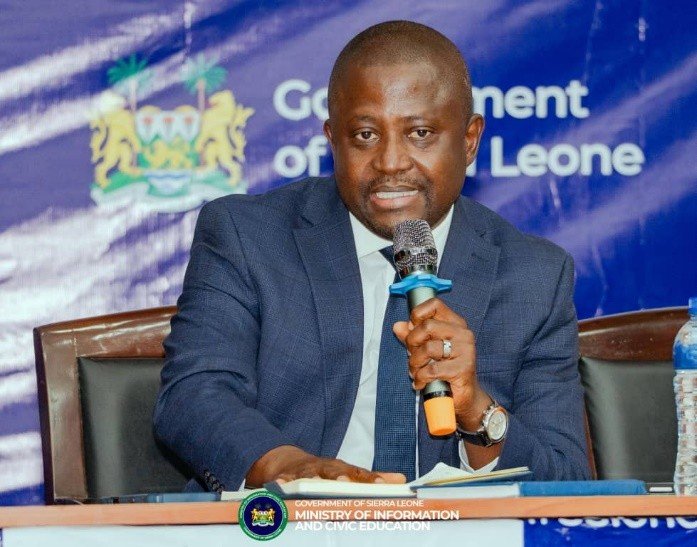
The Attorney General and Minister of Justice, Alpha Sesay Esq., has traced the renewed national call for a new constitution to key post-conflict frameworks, notably the 1999 Lomé Peace Accord and the Report of the Truth and Reconciliation Commission (TRC), describing constitutional reform as a long-standing national obligation rather than a partisan agenda.
Mr. Sesay made these remarks while addressing journalists during the government’s weekly press briefing on Tuesday, January 26, 2026. He emphasized that the current constitutional reform process is firmly anchored in recommendations made at critical moments in Sierra Leone’s history, particularly during the transition from civil war to peace and democratic governance.
According to the Attorney General, the Lomé Peace Accord—signed between the Government of Sierra Leone, the Revolutionary United Front (RUF), and international partners—explicitly called for a comprehensive review of the 1991 Constitution. He explained that the accord recognized structural weaknesses within the existing constitutional framework and warned that failure to address them could leave the country vulnerable to future instability.
“The Lomé Peace Accord was not only about ending the war; it was about preventing the recurrence of conflict,” Mr. Sesay said. “One of its clear recommendations was that the 1991 Constitution be reviewed to ensure that governance structures promote inclusion, justice, accountability, and national cohesion.”
He further noted that these concerns were later reinforced by the Truth and Reconciliation Commission, which was established to examine the root causes of Sierra Leone’s civil war. The TRC Report, he said, went beyond documenting atrocities and abuses, and made far-reaching recommendations aimed at reforming state institutions, including the constitutional order.
Mr. Sesay explained that the TRC identified constitutional deficiencies as contributing factors to governance failures, political exclusion, and public mistrust in state institutions. As a result, the commission strongly advocated for constitutional reform as a critical tool for strengthening democracy, protecting human rights, promoting the rule of law, and consolidating sustainable peace.
Tracing the evolution of the reform process, the Attorney General stressed that successive governments have acknowledged and acted upon these recommendations. He recalled that under the late President Dr. Ahmed Tejan Kabbah, the Peter Tucker Constitutional Review Committee was established to examine the 1991 Constitution and propose reforms aligned with the country’s post-war realities.
He added that this effort was later advanced during the administration of former President Dr. Ernest Bai Koroma, who set up the Justice Edmond Cowan Constitutional Review Committee. That committee conducted extensive consultations nationwide, gathering views from citizens, civil society organizations, traditional leaders, political parties, and other stakeholders on the kind of constitution they wanted for Sierra Leone.
“The Justice Cowan Committee produced a comprehensive report that reflects the voices and aspirations of Sierra Leoneans from all walks of life,” Mr. Sesay noted. “That report did not emerge overnight; it was the product of years of engagement and national dialogue.”
He emphasized that the current administration, led by President Julius Maada Bio, is not initiating a new or isolated agenda, but is implementing the recommendations of the Justice Cowan Committee, albeit with some modifications to reflect evolving national priorities and legal considerations.
“The government of President Julius Maada Bio is committed to completing this historic process,” the Attorney General affirmed. “We are building on what already exists, guided by national consensus documents, and ensuring that the final outcome is a constitution that truly reflects the will, interests, and future aspirations of the people of Sierra Leone.”
Mr. Sesay also addressed concerns and criticisms surrounding the reform process, stressing that constitutional change should be understood as a national project rooted in peacebuilding and democratic consolidation. He urged citizens to engage constructively with the process and to see it as an opportunity to strengthen governance and national unity.
In concluding his remarks, the Attorney General reiterated that constitutional reform remains central to Sierra Leone’s long-term stability. He described the process as a moral and historical responsibility arising from the country’s painful past and its determination to secure a more just and inclusive future.
“A strong, people-centered constitution is essential to ensuring that Sierra Leone never again descends into conflict,” he said. “This reform is about safeguarding peace, deepening democracy, and laying a solid foundation for generations to come.”