By Mackie M. Jalloh
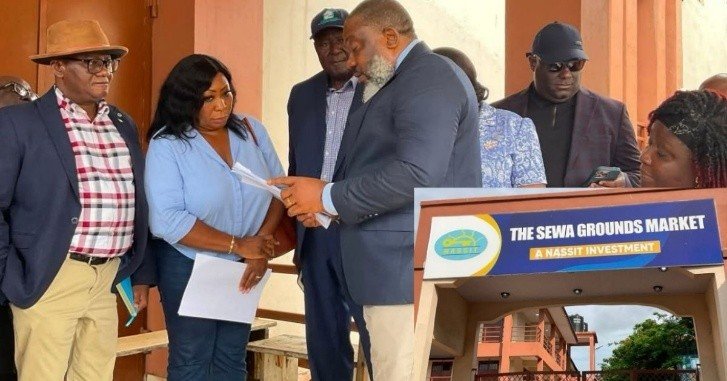
Freetown’s commercial landscape is set for a major shift as the newly completed Sewa Ground Market prepares to officially open its doors on September 1, 2026, with all available trading spaces already taken by merchants.
The full occupancy of the facility ahead of its formal commissioning signals strong demand for organised trading spaces in the capital, particularly after authorities announced a 50 per cent reduction in rental charges.
The development was disclosed by Lansana Koroma, Managing Director of Sierra Estate Management Company Limited (SEMCO), who said the decision to reduce the cost of renting stalls has significantly improved access to the market and encouraged traders to secure spaces.
According to Koroma, traders have responded quickly to the reduced rates, resulting in the facility reaching full capacity even before the official opening.
“Trading will start at the Sewa Ground Market on the 1st of September,” he said.
The development comes against the backdrop of longstanding concerns over the growth of informal trading across Freetown. Pavements, road shoulders and other public spaces in several parts of the capital have increasingly become commercial points, creating challenges for pedestrians, motorists and city authorities.
The new market is therefore being viewed not simply as another commercial facility, but as part of a broader effort to reorganise trading activities and create designated spaces where merchants can operate in a more structured environment.
Reduced Rent Drives Demand
One of the key factors behind the market’s rapid occupancy is the decision to cut rental prices by half.
The reduction followed a pronouncement by President Julius Maada Bio, aimed at making the facility more affordable for ordinary traders.
For many small scale traders, the cost of securing formal commercial space has traditionally been a major barrier. The reduced rates could therefore provide an opportunity for more traders to transition from roadside and informal operations into a regulated market environment.
SEMCO’s confirmation that all spaces have been occupied suggests that affordability has played a significant role in attracting traders.
However, the real test will begin after September 1, when trading officially commences and merchants begin operating from the facility.
A Project with a Long Political and Construction History
The Sewa Ground Market also carries a history that stretches across different political administrations.
The project was initiated under the government of former President Ernest Bai Koroma, but its development was marked by various phases of construction, demolition and delays before eventually reaching completion under the administration of President Bio.
Its eventual completion places the facility among projects that have moved across administrations before becoming operational.
The opening therefore represents not only the beginning of commercial activities at the market, but also the conclusion of a lengthy development process.
Potential Impact on Street Trading
One of the biggest expectations surrounding the new facility is its potential impact on street trading.
Freetown has long struggled with congestion linked to the concentration of commercial activities along major roads and pedestrian routes. Traders operating in unregulated spaces can contribute to blocked walkways, reduced road capacity, waste management challenges and difficulties for emergency and public service vehicles.
By providing dedicated trading spaces, the Sewa Ground Market could help authorities move merchants away from some of the busiest streets.
But achieving that objective will depend on more than simply opening the market.
Authorities will need to ensure that traders have sufficient incentives to remain inside the facility, while enforcement and city planning measures may be required to prevent the gradual return of roadside trading.
A New Test for Market Management
With the market now reportedly fully occupied, management will face the task of maintaining order, cleanliness, security and effective administration once trading begins.
The success of the facility will ultimately be measured by whether it provides traders with a commercially viable environment while also delivering the wider public benefits expected from a modern market.
For traders, issues such as customer accessibility, stall management, security, sanitation and affordability will remain important after relocation.
For the wider city, the expectation is that the market will contribute to a cleaner and better organised commercial environment.
The September 1 opening will therefore mark more than the start of trading at a newly completed facility. It will be a practical test of Freetown’s efforts to bring informal commerce into organised spaces while balancing the livelihood needs of thousands of traders with the city’s growing demands for better traffic management and urban planning.
With 100 per cent occupancy already recorded, the immediate challenge is no longer attracting traders.
The challenge now is ensuring that the Sewa Ground Market delivers on the promise that came with its construction a sustainable, affordable and well managed commercial centre capable of changing how trading is conducted in Freetown.