
By Mackie M. Jalloh
The National Petroleum Regulatory Authority (NPRA) has issued a stern warning to petroleum dealers across Sierra Leone, declaring that any form of price fixing or cartel-like behavior in the fuel market will not be tolerated under the country’s new competitive petroleum regime.
The warning was delivered by the Director General of NPRA, Brima Baluwa Koroma, as concerns mount over uniform pump prices following the recent adjustment of the national fuel price ceiling. Koroma made it clear that the petroleum sector has fully transitioned from a controlled or monopolistic structure into a liberalized and competitive market, where operators are expected to compete independently rather than act in concert.
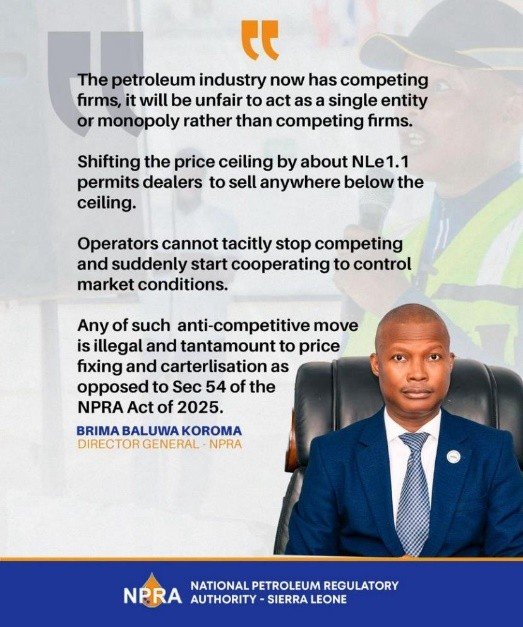
According to the NPRA Director General, the recent upward adjustment of the fuel price ceiling by approximately NLe 1.1 was not intended to impose a fixed selling price on dealers. Instead, the ceiling was deliberately set to create flexibility within the market, allowing petroleum dealers to determine their own pump prices below the approved maximum, based on factors such as operational costs, supply chains, logistics, and business strategies.
Koroma explained that the idea behind the new pricing framework is to encourage healthy competition, innovation, and efficiency within the petroleum sector. “The market is no longer controlled by a single entity or a few dominant players. Multiple companies are now operating, and competition must be allowed to function,” he said. “When dealers all sell at exactly the same price, it raises serious concerns about anti-competitive conduct.”
He warned that any attempt by fuel dealers to act collectively—whether through formal agreements or informal understandings—to influence prices or restrict competition constitutes price fixing and cartelisation. Such actions, he stressed, are illegal and undermine the very purpose of market liberalization.
The NPRA Director General referenced Section 54 of the NPRA Act of 2025, which explicitly prohibits anti-competitive practices in the petroleum industry. Under the law, companies or individuals found guilty of price fixing, collusion, or market manipulation face severe penalties, including fines, sanctions, and possible withdrawal of operating licenses.
Koroma further assured consumers that the Authority is actively monitoring the petroleum market nationwide. He disclosed that NPRA has strengthened its surveillance and compliance mechanisms to detect unusual pricing patterns, coordinated behavior among dealers, and other practices that could harm consumers.
“Our responsibility is to protect the public interest,” Koroma stated. “We will not hesitate to take decisive enforcement action against any operator found violating the law. The objective of this pricing framework is to promote fairness, transparency, and affordability, while ensuring that consumers benefit from competition.”
He also encouraged consumers to report suspected cases of price manipulation or unfair practices, noting that public vigilance is critical to maintaining a transparent and accountable petroleum sector.
The NPRA boss emphasized that a competitive market benefits not only consumers through potentially lower prices, but also serious investors who operate within the law. He warned that allowing cartel behavior to persist would discourage genuine competition and reverse the gains made through recent petroleum sector reforms. As Sierra Leone continues to reform its energy and petroleum landscape, NPRA maintains that strict enforcement of competition laws remains central to ensuring a fair, efficient, and consumer-focused fuel market.