
By Mackie M. Jalloh
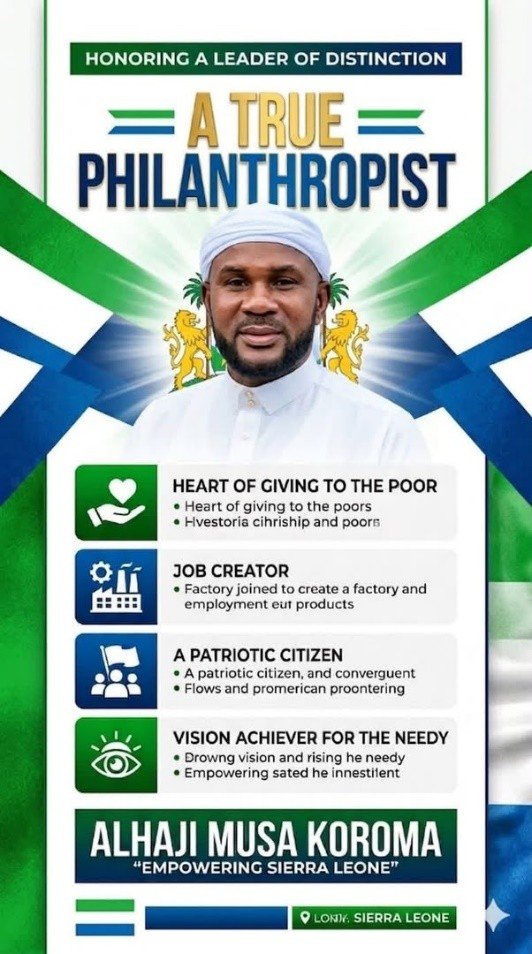
In a country where many successful entrepreneurs often remain behind the scenes, Alhaji Musa Koroma, popularly known as “Musa Dollar,” has become one of Sierra Leone’s most recognizable business and philanthropic figures. His name is increasingly associated not only with business success but also with a culture of giving that has touched the lives of thousands of ordinary Sierra Leoneans.
Over the years, Musa Koroma has built a reputation as a businessman with an extraordinary commitment to supporting vulnerable communities. From food distributions to direct financial assistance for struggling families, students, widows, and the elderly, his charitable activities have made him a household name in many parts of the country.
What distinguishes Musa Koroma from many successful entrepreneurs is his visible connection with ordinary people. While many philanthropists choose to operate quietly, he has consistently taken his humanitarian efforts directly to communities, often engaging personally with beneficiaries. Numerous reports throughout 2025 and 2026 highlighted his regular distribution of food and financial support, particularly during Fridays and religious periods when many vulnerable families face economic hardship.
For many beneficiaries, these interventions are more than charitable gestures. They represent hope during difficult times. In communities where unemployment and rising living costs continue to challenge families, such support has provided relief to countless households struggling to meet their daily needs.
Beyond philanthropy, Musa Koroma’s rise in the business sector reflects the growing influence of indigenous entrepreneurs in Sierra Leone’s economy. Supporters often point to his determination, resilience, and business acumen as examples of what can be achieved through hard work and strategic investment. His business interests have contributed to commercial activity, employment opportunities, and the movement of goods and services within the country.
Those who know him describe him as a businessman who understands that success carries social responsibility. This philosophy appears to underpin many of his public activities, where business achievement is often accompanied by community support initiatives.
Like many prominent business figures around the world, Musa Koroma has at times found himself the subject of public discussion and scrutiny. However, supporters argue that visibility and success often attract attention, speculation, and criticism. They maintain that in any democratic society, questions and inquiries are part of public accountability, but that fairness also requires respect for due process and the presumption of innocence.
Many of his admirers believe that his years of public service through philanthropy should not be overlooked when assessing his contribution to society. They point to the thousands of people who have directly benefited from his generosity and the numerous communities that have welcomed his interventions.
Religious leaders, community stakeholders, youth groups, and beneficiaries have frequently praised his willingness to give back to society. In a nation where social welfare needs remain significant, many view his charitable efforts as a complement to broader development initiatives.
Perhaps the most remarkable aspect of Musa Koroma’s public image is the consistency of his outreach. Philanthropy for him appears not to be an occasional event but a sustained commitment. Week after week, his charitable activities have continued to attract attention and appreciation from beneficiaries across Sierra Leone.
As Sierra Leone continues its journey toward economic growth and social development, individuals who invest both in business and in people are increasingly recognized for their contribution to national progress. For many supporters, Musa Koroma embodies this dual role—an entrepreneur who has achieved business success while remaining connected to the struggles and aspirations of ordinary citizens.
Whether viewed through the lens of business leadership or humanitarian service, Musa Koroma’s story is one that continues to resonate across Sierra Leone. His supporters see him as a symbol of generosity, perseverance, and community empowerment a businessman whose influence extends far beyond commerce and into the lives of the people he serves.
In the eyes of many Sierra Leoneans, Musa Koroma’s legacy is being shaped not merely by the wealth he has accumulated, but by the lives he has touched, the communities he has supported, and the hope he has inspired among those who need it most.