By Mackie M. Jalloh
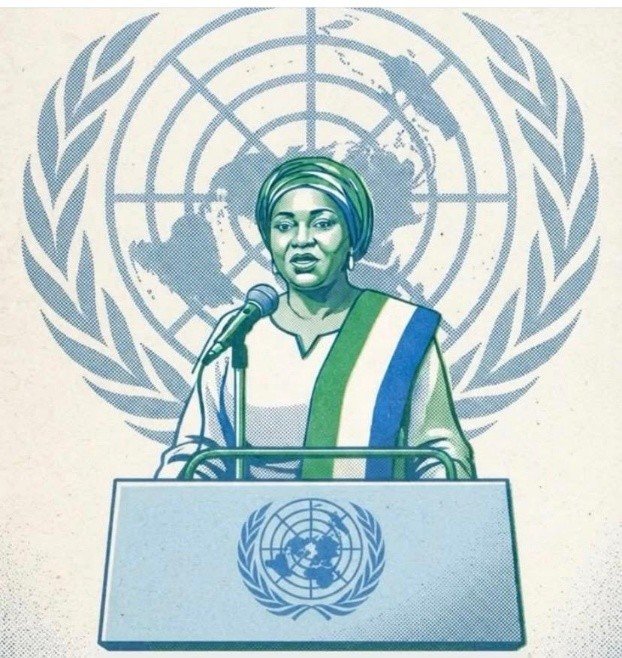
Sierra Leone’s First Lady, Her Excellency Dr. Fatima Maada Bio, is set to return to the global stage on September 4, 2026, to lead a renewed international push against Child, Early and Forced Marriage (CEFM), with a proposed United Nations resolution seeking the establishment of an International Day to End Child Marriage.
The proposed initiative represents another significant chapter in Dr. Bio’s sustained advocacy for the protection, dignity and future of girls. Her appearance before the United Nations General Assembly in New York is expected to place Sierra Leone at the centre of a global conversation on one of the most persistent forms of inequality affecting girls and young women.
According to information from the Office of the First Lady, Dr. Bio will present the draft resolution on September 4, building on the United Nations General Assembly’s adoption in December 2024 of a global resolution addressing the elimination of child, early and forced marriage. The new proposal seeks to institutionalise an annual international day that would keep the issue firmly on the international agenda and strengthen global mobilisation against the practice.
The significance of the proposed International Day goes beyond symbolic recognition. For Sierra Leone, it would represent an opportunity to transform years of advocacy into a permanent international platform for awareness, prevention, accountability and action.
From Sierra Leone’s “Hands Off Our Girls” to the World
Dr. Bio’s campaign against violence and harmful practices affecting women and girls has been closely associated with the Hands Off Our Girls initiative, which has become one of the most recognisable advocacy platforms for girls’ protection in Sierra Leone.
The campaign has focused on issues including rape, early marriage and sexual and gender-based violence, while also promoting education, access to justice and greater protection for vulnerable girls. The Office of the President describes Hands Off Our Girls as a flagship initiative aimed at ending rape, early marriage and violence against women and girls.
Her advocacy has also gained international recognition. UNAIDS appointed Dr. Bio as a Champion for the empowerment and engagement of adolescent girls and young women in Sierra Leone in 2023. She has additionally championed global action on the prevention and healing of child sexual exploitation, abuse and violence.
Her proposed UN resolution therefore comes as part of a longer trajectory rather than an isolated diplomatic intervention.
It is a continuation of the argument that protecting girls requires more than national legislation. It requires international commitment, sustained public education, stronger institutions, survivor-centred responses and investment in girls’ education and economic opportunities.
Why the September 4 UN Moment Matters
Child marriage is not simply a family or cultural issue. It can have profound consequences for a girl’s education, health, economic independence, personal safety and ability to determine the direction of her own life.
When girls are married before they are ready, the consequences can extend across generations. Early marriage can contribute to school dropout, early pregnancy, vulnerability to violence and reduced economic opportunities.
For that reason, the proposed international day could provide governments, civil society organisations, development partners, schools and communities with a recurring global platform to assess progress and renew commitments.
For Sierra Leone, the initiative also provides an opportunity to showcase the country’s experience in placing girls’ rights at the centre of national advocacy.
Dr. Bio has repeatedly taken Sierra Leone’s message beyond the country’s borders, positioning the protection of women and girls as an issue requiring collective international responsibility.
A Broader Health and Women’s Rights Legacy
The September 4 engagement also comes at a moment when Dr. Bio’s international profile is expanding beyond child protection.
On August 26, 2026, OncoDaily published its 2026 list of 100 Influential Women in Oncology, with Dr. Bio among the first group of women recognised. The publication highlighted her work in women’s health and cancer prevention, including efforts to strengthen cancer care capacity and specialist medical training in Sierra Leone.
Her work in healthcare has included advocacy for breast cancer awareness and early detection, while her partnership with the Merck Foundation has supported specialist medical training and the development of Sierra Leone’s cancer care workforce.
Her healthcare advocacy complements her work on girls’ rights because both are rooted in the same broader principle: women and girls should not be left behind because of their gender, age or circumstances.
UN Habitat similarly recognizes Dr. Bio as an advocate for women, girls and gender equality, noting her work from grassroots communities to the United Nations and her efforts around healthcare infrastructure, gender-based violence and child protection.
Sierra Leone’s Voice on the Global Stage
The September 4 engagement will therefore carry significance beyond the First Lady herself.
It will be a moment for Sierra Leone to present its experience, advocacy and aspirations to the international community.
If adopted, the proposed International Day to End Child Marriage could provide a recurring mechanism through which the world is reminded that ending child marriage cannot be achieved through declarations alone. It requires measurable national action, community engagement, enforcement of protective laws, investment in girls’ education and meaningful participation of young people and survivors.
The proposed initiative also reinforces Sierra Leone’s growing diplomatic and advocacy role on issues affecting women and children.
For Dr. Bio, the September 4 appearance is another opportunity to convert the voice of Sierra Leonean girls into a global call for action.
From Hands Off Our Girls to the United Nations, her message remains centred on the same fundamental principle: a girl’s childhood should not be taken away through marriage, violence or coercion.
As the world turns its attention to New York on September 4, Sierra Leone’s First Lady will be carrying a message that reaches far beyond the walls of the United Nations a message about education, dignity, protection, equality and the right of every girl to determine her own future.
The proposed International Day would not merely mark a date on the international calendar. It would seek to keep the fight against child marriage visible every year until the practice is no longer a reality for girls anywhere in the world.