
By Marion Rion Bangura
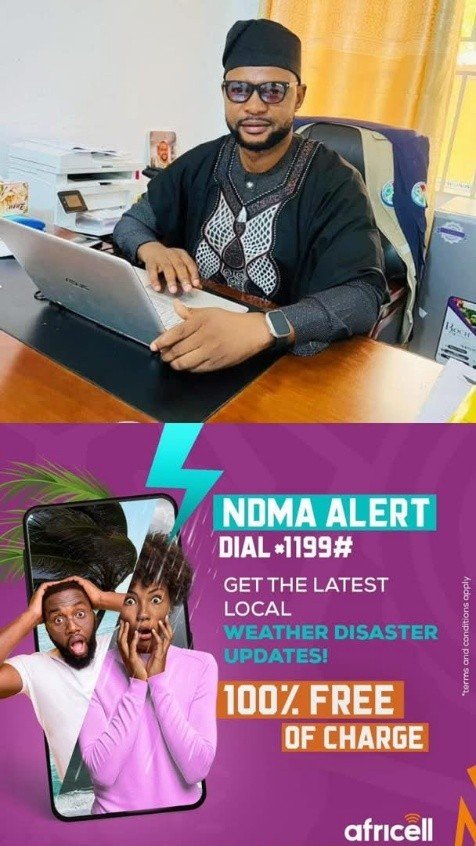
Sierra Leone’s National Disaster Management Agency (NDMA) says the use of its emergency reporting system has increased significantly, with the Agency revealing that Africell Sierra Leone’s 1199 toll-free line now accounts for more than 65 percent of disaster related reports received from the public.
The development highlights the growing role of telecommunications in strengthening disaster preparedness and emergency response, particularly by providing communities with a direct and cost-free channel through which they can alert authorities about incidents.
According to NDMA Director of Communication, Mohamed L. Bah, the 1199 service has become a critical tool in the Agency’s efforts to improve communication between disaster management authorities and members of the public.
Speaking in an interview, Bah explained that the partnership with Africell has made it easier for people to alert the relevant authorities when they encounter emergencies or situations that require intervention.
He said the service has removed some of the barriers that previously prevented members of the public from reporting disasters promptly.
Before the toll free line became widely available and promoted, Bah said, people often had to physically travel to NDMA offices or search for the Agency’s contact information before they could report an emergency.
Such difficulties, he noted, could cause delays in the transmission of critical information, particularly when incidents require urgent assessment and response.
With the introduction and wider use of the 1199 line, however, members of the public can now communicate directly with the Agency without worrying about the cost of making a call.
Bah said the impact of the initiative is reflected in the volume of calls being received through the service.
“Today, about 65% of the disaster-related calls we receive come through the Africell 1199 toll-free line,” he said.
He described the figure as a significant achievement for the Agency, noting that quick access to information is an essential component of effective disaster management.
The NDMA communication director said the ability of citizens to report incidents immediately can help authorities receive early warnings about potential disasters and take appropriate steps to assess situations and coordinate responses.
For disaster management institutions, early information can be particularly important in situations involving flooding, fires, landslides, accidents, structural failures and other emergencies that may threaten lives and property.
Bah further described the arrangement with Africell as one of the NDMA’s most important collaborations with the private sector, stressing the value of partnerships between government institutions and telecommunications companies in improving public safety.
The 1199 service has also strengthened the role of ordinary citizens in disaster management by making them active participants in the reporting process.
Rather than relying solely on officials to identify emergencies, communities can now communicate information about incidents directly to the Agency, potentially allowing response teams to receive alerts from areas where government personnel may not be immediately present.
The growing reliance on the toll-free line also demonstrates how accessible communication technology can support national disaster preparedness.
For a country such as Sierra Leone, where communities can be exposed to a range of natural and human-induced emergencies, effective communication remains central to reducing risks and protecting lives.
However, the effectiveness of an emergency reporting mechanism ultimately depends not only on its accessibility but also on the capacity of institutions to respond appropriately to information received.
The NDMA’s latest figures therefore place greater emphasis on the need for continued investment in disaster response systems, public awareness and coordination among agencies responsible for emergency management.
Bah said the Agency remains committed to improving its communication mechanisms and ensuring that people have reliable channels through which they can report emergencies.
The 65 percent figure, he added, demonstrates that members of the public are increasingly embracing the 1199 service as a trusted avenue for reporting disaster-related incidents.
As Sierra Leone continues to strengthen its disaster preparedness architecture, the NDMA’s experience with the 1199 toll-free service points to the importance of making emergency reporting systems accessible, affordable and easy to use.
The Agency’s partnership with Africell therefore represents more than a telecommunications arrangement; it provides a practical link between communities and disaster management authorities, potentially helping to ensure that warnings and reports reach the appropriate institutions when they matter most.