
By Mackie M. Jalloh
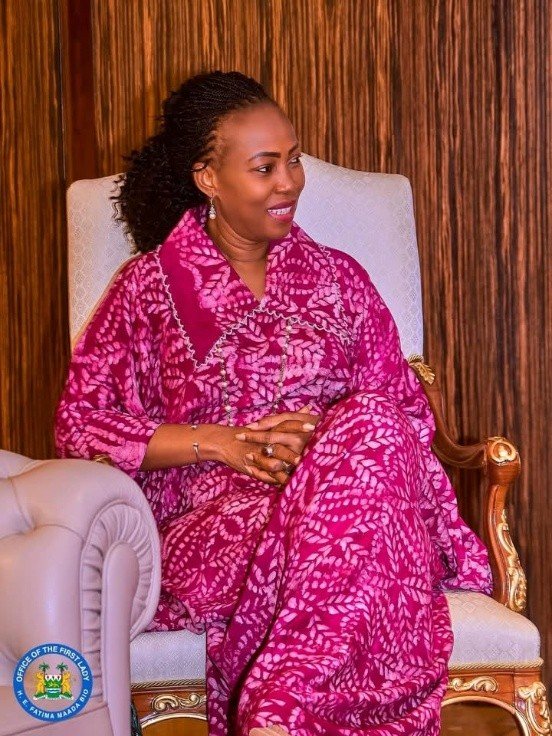
First Lady of Sierra Leone and President of the Organisation of African First Ladies for Development (OAFLAD), Dr. Fatima Maada Bio, has called for stronger investment in women and girls across Africa, saying the continent’s future is inseparable from the wellbeing, empowerment, and advancement of its female population.
Dr. Fatima Bio made the call in Luanda, Angola, where she addressed an evening gathering focused on mobilising support and resources for initiatives aimed at improving the lives of women and girls across the continent.
Speaking before an audience of partners, advocates, philanthropists, and other stakeholders, the First Lady said the gathering was about more than celebrating Africa’s culture, friendship, and achievements. She said it was an opportunity to reaffirm a shared commitment to building a better future for African women and girls.
She described Africa’s women as extraordinary contributors to their families and communities, highlighting the resilience of women who work tirelessly to provide for their families and those who continue to pursue opportunities despite poverty and other social and economic barriers.
According to Dr. Fatima Bio, young African girls are also carrying ambitious dreams of becoming doctors, engineers, teachers, entrepreneurs and even national leaders. She noted that these aspirations demonstrate the enormous potential that exists among Africa’s younger generation.
However, she warned that many of these dreams continue to face serious obstacles, including HIV, gender-based violence, child marriage, poverty, inadequate access to quality education and limited healthcare services.
“These are not merely development challenges; they are deeply personal human stories,” she said, stressing that behind every statistic is a woman, a girl, a family and a community whose future can be transformed through timely intervention.
The First Lady also highlighted the longstanding role of African First Ladies in advocating for women’s rights, maternal and child health, girls’ education, HIV prevention and broader social development.
She said that for almost three decades, African First Ladies have worked collectively as advocates, conveners and champions of change, using their platforms to draw attention to issues affecting women and children across the continent.
Dr. Fatima Bio, however, cautioned that advocacy and compassion must be supported by concrete resources if meaningful progress is to be achieved.
She argued that good intentions alone cannot build schools, provide medicines or sustain programmes designed to support vulnerable communities.
“Compassion alone does not build schools. Hope alone does not provide medicine. Good intentions alone do not fund programmes,” she said.
The First Lady therefore described the event not merely as a fundraising dinner, but as an “investment dinner,” emphasising that financial contributions toward women and girls should be viewed as long-term investments in Africa’s development.
She explained that every contribution has the potential to create measurable change. Such support, she said, could help provide life-saving treatment to a mother living with HIV, keep a vulnerable girl in school rather than expose her to child marriage, or empower a young female entrepreneur whose business could generate employment and opportunities for others.
Dr. Fatima Bio further challenged the notion that investing in women is simply a social intervention, arguing that women are central to the development and transformation of African societies.
She asked the audience to consider the women who raised the doctors, teachers, entrepreneurs, national leaders and other professionals contributing to the continent’s development.
“If we genuinely believe in Africa’s future, then we must also believe in the women who shape that future every single day,” she stated.
The Sierra Leonean First Lady called for collective action to ensure that Africa’s women and girls are not left behind in the continent’s development agenda.
She urged partners and supporters to transform generosity into opportunities, compassion into practical action, and hope into sustainable change.
Dr. Fatima Bio said future generations should be able to look back and recognise that today’s generation did not merely witness the challenges facing Africa, but united around a common purpose and took meaningful steps to address them.
She concluded by expressing appreciation to the partners and supporters for their friendship, collaboration and generosity, while reaffirming her commitment to advancing the wellbeing and empowerment of women and girls across Africa.
“May God bless our beloved Africa,” she said.