
By Mackie M. Jalloh
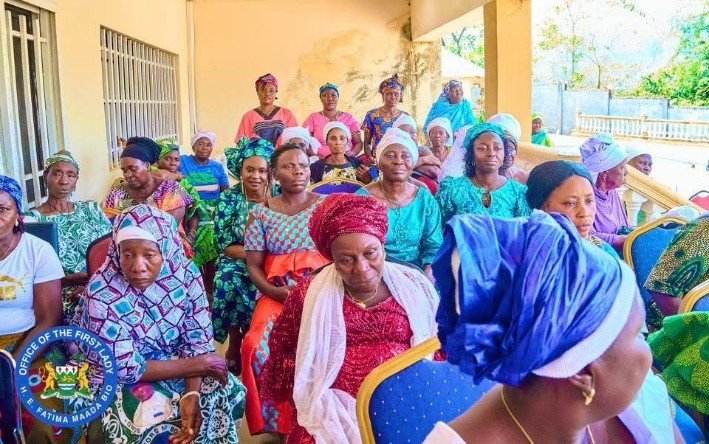
The Kenema Sowei Council, accompanied by Mammy Queens from the eastern region, has formally expressed deep appreciation to Her Excellency, the First Lady of the Republic of Sierra Leone, Dr. Fatima Maada Bio, for what they described as her unwavering dedication to the preservation, protection, and dignified promotion of Sierra Leone’s cultural heritage, particularly as it relates to women and traditional institutions.
The appreciation was conveyed during a courtesy visit to the First Lady, where senior members of the Sowei Council and respected Mammy Queens gathered to acknowledge Dr. Bio’s consistent public and institutional support for indigenous traditions. The delegation emphasized that, at a time when many traditional systems face erosion due to modernization, external influence, and misrepresentation, the First Lady’s posture has offered reassurance and renewed legitimacy to cultural custodians across the country.
Speaking on behalf of the Council, representatives highlighted Dr. Fatima Maada Bio’s visible respect for the Sowei institution and its leadership structure. They noted that her engagement with cultural actors has gone beyond symbolism, reflecting a deeper understanding of the role traditional women-led institutions play in social cohesion, moral education, and community stability. According to the Council, such recognition from the Office of the First Lady has helped elevate the status of cultural practitioners who have often felt sidelined in national discourse.
The Mammy Queens, who hold significant influence in community governance and women’s affairs, echoed similar sentiments. They praised the First Lady for acknowledging the historical and contemporary role of women as custodians of culture, mediators in communities, and transmitters of values across generations. For them, Dr. Bio’s approach represents a rare balance—one that affirms tradition while remaining conscious of the need to protect the dignity and rights of women within cultural systems.
Members of the delegation also stressed that the Sowei institution, when properly respected and responsibly guided, remains central to the identity of many communities in Sierra Leone. They expressed gratitude that the First Lady has consistently resisted narratives that either demonize or trivialize indigenous practices, choosing instead to promote dialogue, reform where necessary, and mutual respect between tradition and modern governance.
In her response, First Lady Dr. Fatima Maada Bio warmly welcomed the Kenema Sowei Council and Mammy Queens, describing their visit as both meaningful and encouraging. She reaffirmed her longstanding commitment to supporting culture and tradition as foundational pillars of national identity. Dr. Bio emphasized that culture should not be treated as a relic of the past, but as a living system that must be protected, understood, and responsibly sustained.
The First Lady underscored the importance of preserving indigenous values while ensuring that cultural practices evolve in ways that empower women rather than marginalize them. She noted that women are not merely participants in culture, but central architects of its survival, and that any serious effort to protect Sierra Leone’s heritage must place women at the core of that mission.
Dr. Bio further assured the Council of her continued support for initiatives that promote cultural education, intergenerational knowledge transfer, and respect for traditional leadership structures. She encouraged the Sowei Council and Mammy Queens to continue playing constructive roles in their communities, particularly in mentoring young women and fostering unity at the grassroots level.
The meeting concluded on a note of mutual respect and shared purpose, with both parties affirming the need for sustained collaboration between cultural institutions and national leadership. For the Kenema Sowei Council and Mammy Queens, the engagement reinforced their belief that tradition and progress need not be in conflict. For the First Lady, it reaffirmed her conviction that Sierra Leone’s future is strongest when it is firmly rooted in its cultural foundations.