
By Mariama Bundu
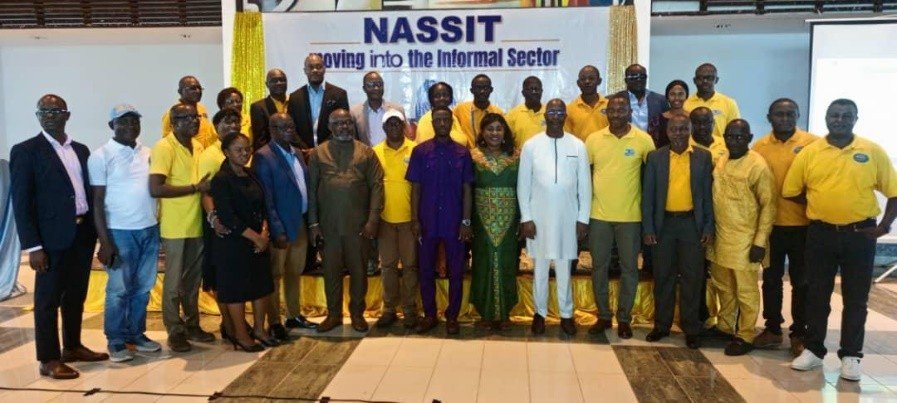
For decades, Sierra Leone’s informal sector has powered the nation’s economy while remaining largely invisible to formal social protection systems. Market women, okada riders, tailors, masons, traders, fishermen, and farmers—despite their vital contributions—have lived with financial uncertainty, often retiring with little or nothing to fall back on. That narrative is now changing as the National Social Security and Insurance Trust (NASSIT) launches a landmark initiative to bring informal workers under its safety net, reshaping the landscape of national inclusion and economic security.
Under the banner of “Every Worker Counts,” NASSIT’s new drive is designed to extend pensions, survivor benefits, and other protections to those previously excluded from formal social security. Mohamed Fuaad Daboh, NASSIT’s Director General, emphasized the transformative potential of the initiative. “We cannot build a secure Sierra Leone when 80 percent of our workforce remains outside the safety net,” he said. “Every worker counts—whether in an office, in the market, or on a motorcycle—and every Sierra Leonean deserves the dignity of retirement security.”
Unlike the rigid monthly contributions typical of formal sector employees, the informal sector initiative introduces a flexible system that reflects the irregular income patterns of small-scale workers. Payments can be made weekly, seasonally, or monthly, depending on when the worker earns. The system also allows for group enrollments through trade unions, market associations, youth organizations, and community-based groups, reducing administrative barriers and making registration accessible even in remote communities.
NASSIT’s outreach teams have taken the campaign directly to the people—touring provinces from Bo to Makeni, Kenema to Port Loko—engaging workers in marketplaces, garages, and fishing communities. Town-hall style meetings have become platforms not just for registration but also for education and empowerment, helping informal workers understand how social protection can provide financial security and stability for their families. “We are not waiting for people to come to our offices; we are taking NASSIT to the markets, the streets, and the communities where they work,” Daboh explained.
The initiative has already produced stories of hope. In Freetown’s Abacha Street, petty trader Alhaji Kanu now proudly displays his NASSIT card, a symbol of inclusion he once thought unattainable. “Before, I believed NASSIT was only for government employees,” he said. “Now I know I am part of it, and I can save little by little knowing that one day I will have something to rely on.” Similarly, Aminata Kamara, a market woman in Dove Cot, expressed her relief and optimism. “Even though my earnings are small, I can now plan for the future. This system gives me hope and security for my family,” she said.
Experts view the expansion of social protection to the informal sector as a critical step for poverty reduction and social stability. Dr. Francis Tucker, a development economist, described the initiative as a social transformation, noting that dignity and economic security should not be exclusive to salaried employees. By creating opportunities for informal workers to participate in national social security, NASSIT is laying the groundwork for a more inclusive, equitable, and resilient economy.
The “Every Worker Counts” initiative represents more than administrative reform; it signals a cultural shift in how Sierra Leone approaches labor, social welfare, and national unity. By ensuring that all contributors—regardless of their employment status—are protected, NASSIT is not only offering retirement security but also fostering trust, empowering communities, and redefining what it means to be part of Sierra Leone’s national development story.
In the words of one market woman in Bo, “For the first time, we feel seen. We feel that the system belongs to us too.” That sense of inclusion, security, and dignity is exactly what NASSIT aims to achieve—proving that in Sierra Leone, every worker truly counts.