
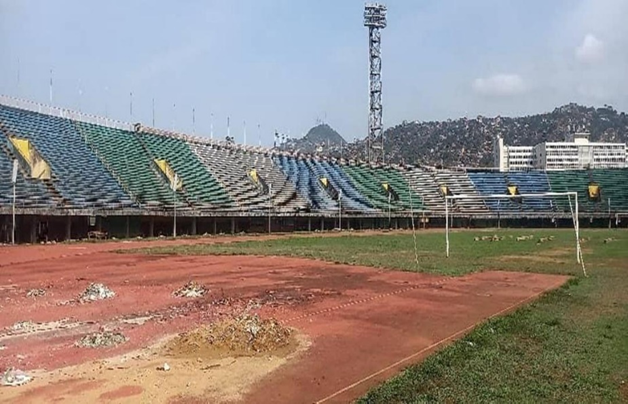
How Authorities Failed the National Stadium Project
By Mackie M. Jalloh
When the gates of the Siaka Stevens National Stadium first closed in February 2022 for what was described as a “major rehabilitation project,” Sierra Leoneans were assured that the inconvenience would be brief. It was presented as a necessary sacrifice for national pride, a short pause before the country would enjoy a modernized, internationally certified arena worthy of hosting global football.
Nearly five years later, the stadium stands as a monument to uncertainty, shifting timelines, vague government assurances, bureaucratic contradictions, and the growing anger of a nation that has been exiled from its own home of football.
This is not just a renovation story — it is a story of institutional failure.
A Pattern of Shifting Promises: From Early 2024 to Late 2026, Then Beyond
While officials have repeatedly insisted that the project is on track, the record tells a much different story. Over time, at least four distinct, officially communicated completion timelines have surfaced — each more unrealistic than the last:
1. Early-2023 / mid-2023:
Authorities projected the stadium would be ready in early 2024. Citizens were told to remain patient. Hope lingered.
2. Mid-2024:
Government statements and media updates shifted the expected completion date to the end of 2024. The public accepted another delay.
3. October 2024:
Following the announcement of a seating installation agreement, officials reassured that the full upgrade would be completed within a year — effectively placing completion around late-2025.
4. May–July 2025:
A new, more drastic revision emerged when Chief Minister Dr. David Moinina Sengeh, after touring the facility with the Chinese Ambassador and senior sports officials, stated that the project was now tracking for another 18–20 months, pushing the projection as far as November 2026 — if no further delays occur.
But the timeline chaos did not end there.
“Soon”: The Government’s New Favorite Deadline
By April 2025, the public’s frustration was palpable. Yet, instead of providing clarity, the Minister of Sports Augusta James-Teima offered only soft assurances that the stadium would be completed “soon.”
No month.
No quarter.
No year.
Just soon.
Her ministry attributed delays partly to slow progress on the installation of stadium seating — a mandatory CAF and FIFA requirement — claiming the bidding process was still ongoing in 2025, three years after renovations began.
This vagueness confirmed what many already suspected:
the government no longer had control of the project timeline.
Contradictions Inside the NSA: Whose Deadline Should the Public Believe?
Internal inconsistencies within the National Sports Authority (NSA) further deepened public distrust:
• September 2025: NSA project supervisor Alie Sesay confidently stated that parts of the stadium would be handed over by October 2025.
That deadline arrived and passed without a single section being delivered.
• Sesay later claimed the stadium would be ready by mid-2026.
• December 8, 2025:
The NSA’s Director of Media and Communications, Eric Batilo Fomba, publicly dismissed Sesay’s projection as unrealistic. Fomba candidly admitted that the China Aid-funded project would not be completed until late 2026 or early 2027.
Two officials.
Two different timelines.
Both contradicting the government’s earlier assurances.
All while the stadium remains closed.
June 4, 2024: A Supervised Tour That Brought No Clarity
On June 4, 2024, Minister Teima and the National Stadium Management conducted a detailed inspection of the rehabilitation works. The tour aimed to reassure citizens that progress was tangible.
But despite the optics, the government quietly shifted from firm deadlines to generalized statements about “progress” and “ongoing work.”
The public was left with photos — not answers.
Who Is Really in Charge?
The Chinese company overseeing the rehabilitation, Gansu Construction Investment (Holding) Group Co. Ltd (GCIGC), had earlier publicly announced that the full renovation — including a practice field and swimming pool — would be completed by May 2024.
That declaration now stands in direct contradiction to the government’s extended timelines stretching into 2027.
Instead of confronting these contradictions, authorities appear to have allowed each party to issue its own projection, leaving the public to interpret the mess.
A National Frustration: Five Years, No Stadium
For a country where football is more than sport — it is identity — the prolonged closure of the national stadium has been devastating.
• Sierra Leone has played several “home” matches abroad.
• Citizens have been deprived of national football in their own capital.
• Local players have lost opportunities to showcase their talent.
• Sports tourism revenue has been erased.
A project that began as a renovation has effectively turned into the construction of a “new stadium” in terms of time consumed — without any of the transparency typically associated with such massive undertakings.
Why the Delays Matter: Trust, Accountability, and the Cost of Silence
Every new deadline that slips erodes public trust in the Ministry of Sports, the NSA, and the entire governance structure overseeing the project. The lack of a consistent, truthful, and accountable communication strategy reflects:
• Poor project management
• Weak oversight mechanisms
• Contradictions between ministries and agencies
• No clear penalties for non-delivery
• A political willingness to use vague language to avoid public backlash
Citizens now openly question whether officials themselves even know when the stadium will reopen — or whether they are simply shielding the public from the reality that the project is badly mismanaged.
The Central Question No One Will Answer
How did a stadium scheduled for completion in early 2024 transform into a five-year ordeal stretching into 2027?
Until government officials, the NSA, and the Chinese contractors provide one unified, verifiable timeline — with transparent documentation — Sierra Leoneans will continue to suspect the worst: that the nation’s only stadium has become a victim of incompetence, miscommunication, and political spin.
A National Asset Held Hostage by Uncertainty
The Siaka Stevens National Stadium is more than concrete and seating — it is where national pride gathers, where dreams form, where unity is celebrated. Yet the very institutions entrusted with protecting this symbol have instead plunged it into years of uncertainty.
Four years of broken timelines.
Four years of vague statements.
Four years without football at home.
The public deserves answers.
The stadium deserves accountability.
And Sierra Leone deserves better.