
ACC Activates Whistleblower Protection
By Mackie M. Jalloh
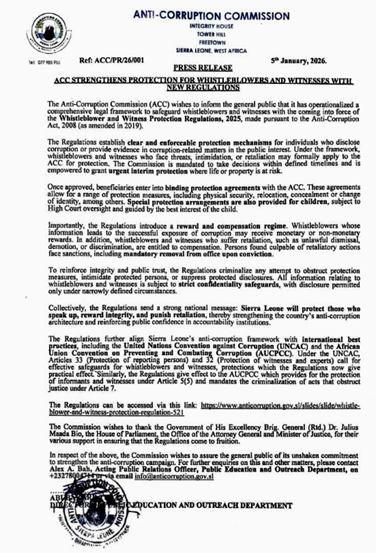
The Anti-Corruption Commission (ACC) has taken a major step toward strengthening Sierra Leone’s anti-corruption architecture with the full operationalization of the Whistleblower and Witness Protection Regulations, 2025, a comprehensive framework designed to protect, reward, and empower individuals who expose corruption or provide critical evidence in corruption-related cases.
The Regulations, which derive their legal authority from the Anti-Corruption Act of 2008 as amended in 2019, mark a significant shift from policy intent to enforceable protection. According to the ACC, the new framework is aimed at dismantling one of the biggest barriers to accountability in Sierra Leone: fear of retaliation against those who speak up.
For years, whistleblowers and witnesses have faced threats, intimidation, dismissal from work, social isolation, and even physical danger. The ACC says the new Regulations directly confront these risks by establishing clear, legally binding protection mechanisms that place the safety and dignity of informants at the center of the anti-corruption fight.
Under the Regulations, any whistleblower or witness who reasonably believes they are at risk as a result of a protected disclosure may formally apply to the ACC for protection. The Commission is now legally empowered to assess such applications within clearly defined timelines and to take swift action where necessary. In cases involving immediate threats to life, safety, or property, the ACC can grant urgent interim protection even before a full assessment is completed.
Once protection is approved, beneficiaries enter into binding protection agreements with the Commission. These agreements outline the scope and nature of protective measures, which may include physical security, safe relocation, concealment of identity, restricted access to personal information, or, in extreme cases, identity change. The ACC emphasized that protection measures are tailored to individual risk assessments to ensure both effectiveness and proportionality.
Special safeguards are also built into the Regulations for children who act as whistleblowers or witnesses. In such cases, protective decisions are subject to oversight by the High Court, with the best interests of the child serving as the guiding principle. This provision reflects a growing recognition that children can be both vulnerable victims and courageous truth-tellers in corruption-related cases.
Beyond protection, the Regulations introduce a reward and compensation regime, a move the ACC describes as both strategic and moral. Whistleblowers whose information leads to the successful detection, investigation, or prosecution of corruption offenses may receive monetary or non-monetary rewards. The Commission says this is intended not to commercialize integrity, but to recognize the personal risk and public value of speaking out.
Equally significant is the compensation framework for whistleblowers and witnesses who suffer retaliation. Individuals who are unlawfully dismissed, demoted, harassed, discriminated against, or otherwise victimized for cooperating with the ACC are entitled to compensation. The Regulations go further by imposing serious consequences on perpetrators of retaliation. Any person convicted of retaliatory acts may face criminal sanctions, including mandatory removal from public office.
To preserve trust in the system, the Regulations criminalize any attempt to obstruct justice, intimidate whistleblowers, suppress disclosures, or interfere with protection measures. All information relating to whistleblowers and witnesses is classified as strictly confidential, with disclosure permitted only under narrowly defined legal exceptions.
The ACC says the Regulations send an unmistakable national message: Sierra Leone will protect those who tell the truth, reward integrity, and punish retaliation. By doing so, the country aims to break the culture of silence that has long enabled corruption to thrive.
Importantly, the framework aligns Sierra Leone with international anti-corruption standards, including the United Nations Convention against Corruption (UNCAC) and the African Union Convention on Preventing and Combating Corruption (AUCPCC). Articles 32 and 33 of UNCAC and Articles 5(5) and 7 of AUCPCC obligate states to protect witnesses and whistleblowers and criminalize obstruction of justice—commitments the ACC says are now firmly embedded in national law.
The Commission acknowledged the role of the Government of His Excellency Brigadier General (Rtd.) Dr. Julius Maada Bio, the House of Parliament, and the Office of the Attorney General and Minister of Justice in supporting the passage and implementation of the Regulations.
Reaffirming its mandate, the ACC assured the public of its continued determination to strengthen accountability, restore public confidence in institutions, and ensure that corruption is confronted decisively at all levels. According to the Commission, the operationalization of the Whistleblower and Witness Protection Regulations represents not just a legal milestone, but a turning point in Sierra Leone’s fight against corruption.