By Mackie M. Jalloh
The Economic Community of West African States (ECOWAS) has issued a carefully worded response to the evolving political and security situation in the Bolivarian Republic of Venezuela, positioning itself as a strong advocate for international law, national sovereignty, and peaceful dialogue at a time of rising global tension.
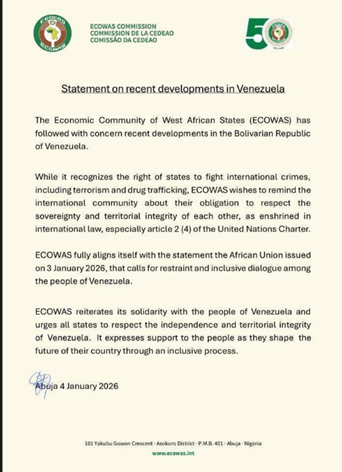
In a statement released from its headquarters in Abuja on 4 January 2026, the regional bloc said it was closely monitoring recent developments in Venezuela, noting with concern actions and counteractions that risk deepening instability in the South American nation. While refraining from assigning blame, ECOWAS emphasized that the current trajectory of events underscores the urgent need for restraint, diplomacy, and respect for established international norms.
ECOWAS acknowledged that all sovereign states retain the legitimate right to combat international crimes such as terrorism, transnational organized crime, and drug trafficking. However, the Commission stressed that such efforts must be pursued strictly within the boundaries of international law. It warned that actions taken outside these legal frameworks could undermine global stability and set dangerous precedents.
Central to ECOWAS’ position is the principle of sovereignty and territorial integrity, which the organization described as non-negotiable pillars of the international system. The Commission recalled Article 2(4) of the United Nations Charter, which prohibits the threat or use of force against the political independence or territorial integrity of any state. According to ECOWAS, adherence to this principle is essential not only for Venezuela, but for the protection of all nations, particularly those in the Global South that have historically suffered from external interference.
In reinforcing its stance, ECOWAS aligned itself with the African Union’s statement issued on 3 January 2026, which called on all parties involved in Venezuela’s situation to exercise restraint and prioritize inclusive dialogue. By echoing the African Union’s position, ECOWAS signaled a growing convergence among regional organizations in Africa around the defense of multilateralism and peaceful conflict resolution.
The Commission underscored that sustainable peace cannot be imposed through pressure or coercion, but must emerge from processes that involve the people themselves. It expressed strong support for an inclusive national dialogue in Venezuela, one that allows citizens across political, social, and ideological lines to participate freely in shaping the future of their country.
“Lasting stability is achieved when the will of the people is respected and when political disagreements are resolved through dialogue rather than confrontation,” the statement noted in substance, highlighting ECOWAS’ belief in homegrown solutions to national challenges.
Beyond diplomatic principles, ECOWAS also struck a tone of solidarity with the Venezuelan population, acknowledging the social and economic hardships many citizens continue to face amid political uncertainty. The organization expressed empathy with ordinary Venezuelans and reaffirmed its support for their right to determine their own political destiny without external pressure.
The statement further urged all states, regardless of their geopolitical interests, to respect Venezuela’s independence and territorial integrity. ECOWAS cautioned that any escalation—whether political, economic, or military—could have far-reaching consequences beyond Venezuela’s borders, contributing to global insecurity at a time when international cooperation is already under strain.
Observers say ECOWAS’ intervention, though geographically distant from Latin America, reflects a broader effort by African institutions to assert moral and legal authority on global issues. Having experienced the consequences of external interference and internal conflict within its own region, ECOWAS has increasingly positioned itself as a defender of dialogue, sovereignty, and multilateral engagement.
The Commission’s statement also highlights the interconnectedness of today’s world, where crises in one region resonate far beyond their immediate surroundings. By speaking out on Venezuela, ECOWAS reinforced the idea that respect for international law is a shared responsibility and that silence in the face of violations anywhere weakens protections everywhere.
As global attention remains fixed on Venezuela, ECOWAS’ message adds to mounting international calls for de-escalation and political engagement. The organization concluded by reaffirming its commitment to peace, solidarity, and the principles of the United Nations Charter, urging the global community to choose diplomacy over division.
In doing so, ECOWAS made clear that its concern is not merely about Venezuela alone, but about safeguarding a rules-based international order in which nations, large and small, can coexist with dignity, equality, and mutual respect.