
By Mackie M. Jalloh
The drive to reduce road crashes and improve transport safety across West Africa received a significant boost after the Sierra Leone Road Safety Authority (SLRSA) and Nigeria’s Federal Road Safety Corps (FRSC) formalized a long term strategic partnership designed to strengthen cooperation, share expertise, and enhance road safety management across the region.
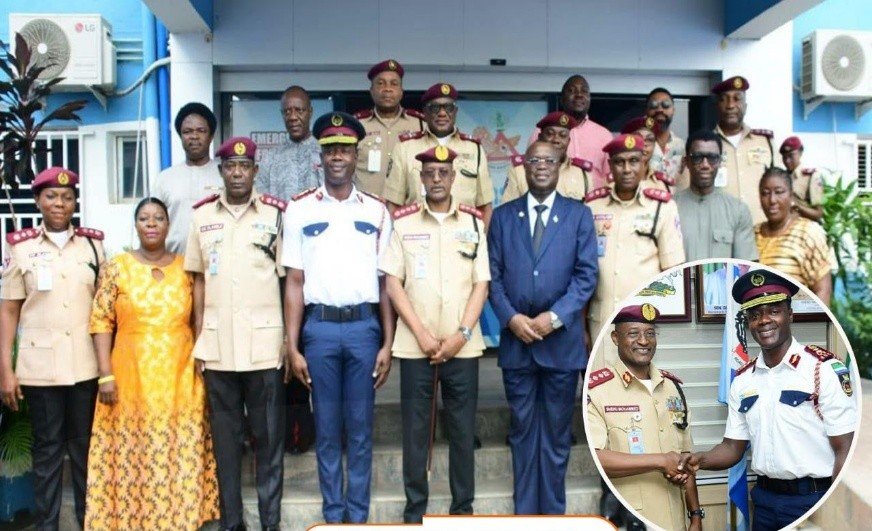
The partnership was sealed through the signing of a five-year Memorandum of Understanding (MoU) at the FRSC National Headquarters in Abuja, Nigeria, bringing together senior government officials, road safety experts, and diplomatic representatives from both countries. The agreement represents a renewed commitment by Sierra Leone and Nigeria to tackle the growing challenge of road traffic accidents through coordinated regional action rather than isolated national efforts.
Road traffic crashes remain one of the leading causes of preventable deaths and injuries across Africa, with governments increasingly recognizing that effective road safety requires stronger collaboration, improved technology, better enforcement mechanisms, and continuous institutional capacity building. Against this backdrop, the agreement between the two agencies is expected to provide a framework for exchanging technical expertise and implementing proven road safety strategies that have delivered positive results in Nigeria.
Under the terms of the Memorandum of Understanding, the Sierra Leone Road Safety Authority and the Federal Road Safety Corps will work closely in several critical areas, including road safety innovation, institutional development, professional training, research, road crash data collection and analysis, vehicle registration and administration, traffic law enforcement, and public education campaigns aimed at promoting safer road use.
The collaboration is also expected to encourage the development of modern systems for monitoring road safety performance, improving operational efficiency, and strengthening evidence-based decision-making. Officials believe that sharing knowledge and best practices will enable both countries to better respond to emerging road safety challenges while creating more resilient transport management systems.
Speaking during the signing ceremony, Executive Director of the Sierra Leone Road Safety Authority, James Bagie Bio, described the agreement as an important milestone in the Authority’s efforts to transform road safety administration in Sierra Leone. He noted that the Federal Road Safety Corps has earned widespread recognition across Africa for its professionalism, operational standards, and technological advancement under the leadership of Corps Marshal Shehu Mohammed.
According to him, Sierra Leone intends to maximize the opportunities created by the partnership by ensuring that the provisions of the agreement are translated into practical action rather than remaining a symbolic commitment. He emphasized that the Authority is determined to immediately begin implementing various aspects of the cooperation framework to strengthen road safety operations throughout the country.
James Bagie Bio stressed that the signing of the Memorandum of Understanding should be viewed as the beginning of a long-term relationship focused on measurable outcomes that will ultimately save lives, improve road user behavior, and strengthen institutional effectiveness.
The Executive Director further acknowledged the importance of learning from countries that have successfully modernized their road safety institutions, stating that Nigeria’s experience offers valuable lessons that Sierra Leone can adapt to its own national context.
Also addressing the gathering, Sierra Leone’s Deputy High Commissioner to Nigeria and Deputy Head of Mission to the Economic Community of West African States (ECOWAS), Major General (Rtd.) Dauda Alpha, described the agreement as an important step toward strengthening regional cooperation in transport safety.
He commended the Federal Road Safety Corps for evolving into one of Africa’s most respected road safety institutions, noting that its achievements have positioned Nigeria as a continental reference point in traffic management, road safety administration, and institutional innovation.
Major General Alpha observed that stronger partnerships among ECOWAS member states are essential for addressing common transport challenges, particularly as increasing regional trade and cross-border movement continue to place greater demands on road infrastructure and traffic management systems.
He said the collaboration between Sierra Leone and Nigeria demonstrates how African institutions can work together to develop practical solutions that benefit citizens across national boundaries while supporting broader regional integration objectives.
The agreement also reflects the Federal Road Safety Corps’ broader strategy of expanding international cooperation under the leadership of Corps Marshal Shehu Mohammed. In recent years, the Corps has continued to strengthen partnerships with regional and international institutions as part of efforts to promote knowledge exchange, improve operational standards, and position itself as a leader in road safety administration on the African continent.
Officials from both organizations expressed confidence that the partnership will create opportunities for joint training programmes, technical exchanges, collaborative research initiatives, and the adoption of innovative technologies capable of improving road safety outcomes in both countries.
Beyond institutional cooperation, the agreement underscores the shared responsibility of governments, enforcement agencies, transport stakeholders, and road users in creating safer roads throughout West Africa. By combining expertise, strengthening enforcement, improving data management, and promoting continuous learning, both agencies aim to contribute to reducing road traffic fatalities while advancing regional development goals.
As implementation of the five-year agreement begins, stakeholders anticipate that the partnership will not only deepen bilateral relations between Sierra Leone and Nigeria but also serve as a model for future collaboration among ECOWAS member states seeking sustainable solutions to one of Africa’s most pressing public safety challenges.