
By Mackie M. Jalloh
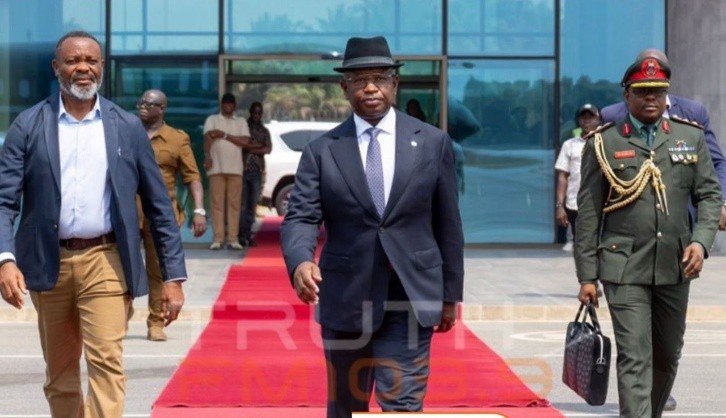
President Julius Maada Bio has departed Sierra Leone for Accra, Ghana, to participate in the High-Level Consultative Conference on Regional Cooperation and Security, convened under the auspices of the Economic Community of West African States (ECOWAS). The conference brings together Heads of State, government officials, and key regional stakeholders to deliberate on pressing security and stability challenges confronting the West African sub-region.
President Bio is attending the conference in his capacity as Chair of the ECOWAS Authority of Heads of State and Government, a role that places him at the forefront of regional efforts to promote peace, democratic governance, and collective security. His participation underscores Sierra Leone’s active engagement in regional diplomacy and its commitment to multilateral approaches to addressing shared threats.
The Accra conference is expected to focus on strengthening regional cooperation in response to evolving security risks, including terrorism, violent extremism, unconstitutional changes of government, transnational organized crime, and cross-border instability. West Africa has in recent years faced growing security pressures, particularly in the Sahel and coastal states, making enhanced coordination among ECOWAS member states increasingly urgent.
Speaking ahead of his departure, President Bio expressed optimism about the forthcoming deliberations, noting that the conference presents an important opportunity for frank dialogue and collective problem-solving. He emphasized the need for ECOWAS leaders to adopt unified and pragmatic strategies that prioritize peace, stability, and the protection of democratic institutions across the region.
“I look forward to engaging my fellow leaders in Accra on how we can strengthen regional cooperation to confront our shared security challenges,” President Bio said. “West Africa’s stability depends on our ability to act together, share intelligence, support one another, and uphold the principles that bind us as a regional community.”
As Chair of the ECOWAS Authority, President Bio has been a vocal advocate for regional solidarity, dialogue, and constitutional order. His tenure has coincided with a period of significant political and security tension in parts of the region, including military takeovers, protracted conflicts, and humanitarian pressures. Observers note that the Accra conference will provide an important platform for assessing current ECOWAS strategies and exploring more effective mechanisms for conflict prevention and resolution.
The High-Level Consultative Conference is also expected to review the effectiveness of existing ECOWAS security frameworks and peacekeeping arrangements, as well as the role of regional institutions in supporting member states affected by insecurity. Discussions are likely to address the need for sustained investment in early warning systems, intelligence-sharing, and joint security operations, alongside political dialogue and socio-economic interventions.
President Bio’s participation is expected to highlight Sierra Leone’s post-conflict experience as a case study in peacebuilding, reconciliation, and democratic recovery. Having emerged from a devastating civil war to become a contributor to regional peace initiatives, Sierra Leone’s perspective is often cited as valuable in ECOWAS discussions on conflict management and institutional reform.
In Accra, President Bio is also expected to hold bilateral engagements with fellow West African leaders on the margins of the conference. These interactions are anticipated to focus on strengthening diplomatic ties, advancing mutual security interests, and reinforcing commitments to regional integration and cooperation.
The conference comes at a critical moment for ECOWAS, as the bloc navigates complex geopolitical dynamics and debates over the most effective responses to security crises within its membership. Analysts suggest that the outcomes of the Accra meeting could shape ECOWAS policy direction in the months ahead, particularly in relation to collective security and regional governance.
President Bio’s attendance further reflects Sierra Leone’s broader foreign policy orientation, which emphasizes multilateralism, regional leadership, and proactive engagement in international and sub-regional affairs. Government officials have described his role as ECOWAS Chair as an opportunity to contribute meaningfully to peace and stability beyond national borders.
The President is expected to return to Sierra Leone after the conclusion of the conference, with outcomes and recommendations from the Accra deliberations likely to inform ongoing ECOWAS initiatives and national policy considerations. As West Africa continues to confront interconnected security challenges, the Accra conference is widely seen as a crucial step toward reinforcing collective action and sustaining regional peace.