By Marion (Rion) Bangura
In a deliberate effort to recalibrate the role of journalism in national development, on Tuesday 31st March 2926, the Independent Commission for Peace and National Cohesion (ICPNC) has concluded an intensive capacity building workshop aimed at strengthening peace centered reporting among media practitioners in Sierra Leone. The engagement, held in Freetown, reflects a growing institutional recognition that the media remains a decisive force in either stabilizing or destabilizing fragile societies.
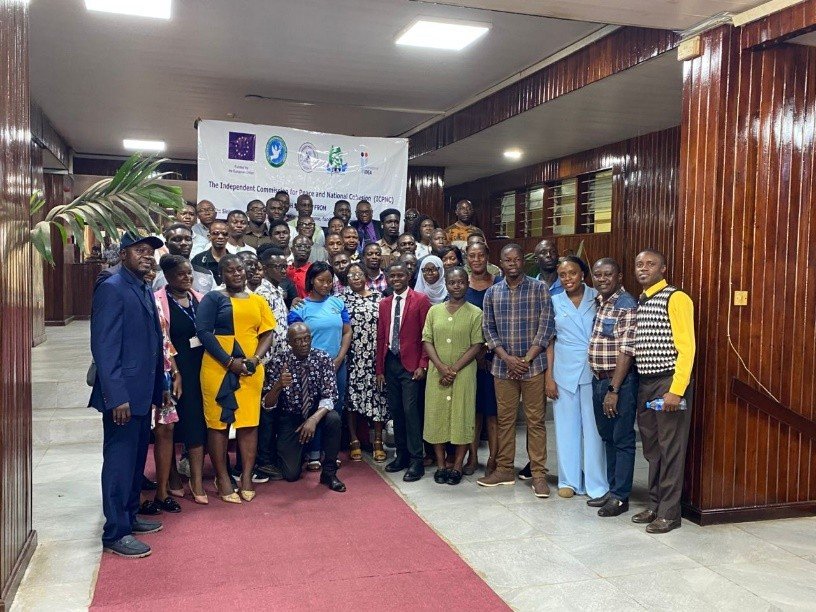
Hosted at the Ministry of Defence premises at Tower Hill, the training brought together more than 100 participants drawn from radio, print, and television institutions across the country. The gathering included reporters, editors, producers, and media executives individuals whose editorial decisions shape public discourse daily. The objective was clear: to reposition the media as a constructive driver of national cohesion in a country still navigating the long term effects of its civil conflict.
Sierra Leone’s media landscape has evolved significantly over the years, expanding both in reach and influence. However, with that expansion comes heightened responsibility. The ICPNC’s intervention underscores concerns that, without proper orientation, media narratives can inadvertently inflame tensions, reinforce divisions, or misrepresent sensitive national issues. This workshop, therefore, was not merely academic; it was a strategic intervention aimed at redefining journalistic responsibility within a peacebuilding framework.
Leading the sessions was Dr. Amara Kargbo, a respected authority in conflict sensitive journalism. His facilitation focused on equipping participants with practical methodologies for responsible reporting, particularly in contexts where misinformation, political polarization, and social fragmentation remain persistent risks. He emphasized that journalism must move beyond routine information dissemination to become an instrument of societal stability.
Throughout the sessions, participants engaged with key thematic areas, including ethical reporting during crises, framing narratives that are inclusive and balanced, and avoiding language that could trigger hostility or deepen societal fault lines. The training also explored how journalists can deliberately amplify voices from marginalized communities, ensuring that public discourse reflects the diversity of Sierra Leonean society rather than privileging dominant perspectives.
A notable component of the workshop was a high level panel discussion featuring seasoned journalists who have successfully integrated peace messaging into their editorial policies. Among them was Fatima Koroma, who shared practical insights on newsroom decision making and the subtle ways headlines, tone, and framing can influence public reaction. Her contribution reinforced a critical point: that journalism is not neutral in impact, even when it aims to be objective in intent.
Participants were not passive recipients of information. The workshop was structured to encourage active engagement, with breakout sessions, scenario based exercises, and peer-to-peer discussions forming a core part of the learning process. Journalists openly examined the operational challenges they face, including editorial pressure, political interference, limited resources, and the demand for sensationalism in competitive media markets. These candid exchanges allowed for the development of context specific solutions grounded in the realities of Sierra Leone’s media environment.
Importantly, the ICPNC signaled that the workshop is part of a broader, sustained engagement rather than a one off intervention. According to the Commission’s leadership, mechanisms are being established to ensure continuity, including follow up trainings and mentorship programs that will pair experienced professionals with emerging journalists. This approach reflects an understanding that institutional change in media practice requires consistency, monitoring, and reinforcement.
The Chairperson of the Commission, Chief Samuel Ngai, reiterated the organization’s long term vision of embedding peacebuilding within national structures, with the media serving as a central pillar. He emphasized that sustainable peace is not solely the responsibility of government or security institutions but must be cultivated through everyday narratives that promote dialogue, tolerance, and mutual respect.
The timing of this initiative is particularly significant. As Sierra Leone continues to consolidate its democratic gains while confronting socio political challenges, the media’s role becomes increasingly sensitive. The line between informing the public and influencing national stability is thin, and the ICPNC’s intervention appears designed to ensure that media practitioners are equipped to navigate that complexity with professionalism and foresight.
By the close of the workshop, participants expressed a renewed sense of purpose, acknowledging the weight of their responsibility in shaping national consciousness. The training has effectively reframed journalism not merely as a profession, but as a civic duty with direct implications for peace and unity.
In practical terms, the success of this initiative will ultimately be measured not by attendance or participation, but by observable shifts in media content across the country. If implemented effectively, the principles shared during the workshop could redefine how stories are told in Sierra Leone prioritizing accuracy, inclusivity, and social cohesion over sensationalism and division.
As the country continues its journey toward sustainable peace, the ICPNC’s engagement with the media sector stands out as a calculated and necessary step. It reinforces a fundamental reality: that in post conflict societies, the battle for peace is often fought not only in political arenas but also in newsrooms, headlines, and broadcast narratives.