
By Mackie M. Jalloh
The 13th Edition of the Merck Foundation Africa Asia Luminary 2026 has once again demonstrated the growing influence of strategic partnerships in addressing some of the most pressing health and social challenges facing developing countries.
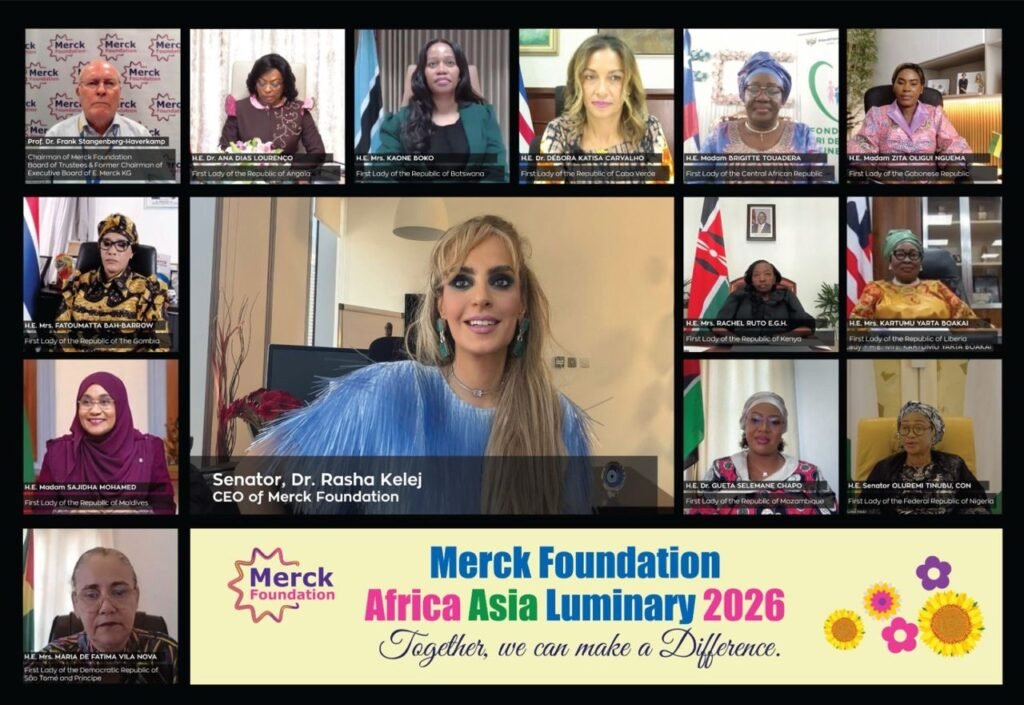
Held virtually on June 18 and 19, the annual conference brought together an impressive coalition of leaders, policymakers, healthcare professionals, media practitioners, academics, and development partners from across Africa and Asia. The event was inaugurated by Prof. Dr. Frank Stangenberg-Haverkamp, Chairman of the Merck Foundation Board of Trustees, and Senator Dr. Rasha Kelej, CEO of Merck Foundation and Chairperson of the Africa Asia Luminary, alongside 12 First Ladies from Africa and Asia who served as Guests of Honor and Keynote Speakers.
The participation of First Ladies from Angola, Botswana, Cabo Verde, Central African Republic, Gabon, The Gambia, Kenya, Liberia, Maldives, Mozambique, Nigeria, and São Tomé and Príncipe highlighted the increasing role of presidential spouses in championing healthcare, education, women’s empowerment, and social transformation within their respective countries.
At the heart of this year’s conference was a renewed commitment to strengthening healthcare systems, addressing social inequalities, and empowering vulnerable populations through sustainable interventions.
Speaking during the opening session, Dr. Rasha Kelej emphasized that the Luminary serves as a platform for sharing experiences and evaluating the impact of programmes designed to transform patient care and tackle critical social and health issues.
For many observers, one of the most remarkable achievements highlighted during the conference was Merck Foundation’s investment in healthcare capacity building. According to the Foundation, more than 2,600 scholarships have been awarded to healthcare providers from 52 countries in 44 critical and underserved medical specialties.
The significance of this initiative cannot be overstated. Across Africa and parts of Asia, shortages of medical specialists continue to undermine healthcare delivery, forcing patients to seek treatment abroad or endure long waiting periods for specialized care. Through these scholarships, many countries have produced their first specialists in areas such as fertility medicine, oncology, endocrinology, reproductive health, psychiatry, and laparoscopic surgery.
The Foundation’s intervention is helping to reduce dependency on foreign medical services while strengthening national healthcare systems from within.
A major focus of this year’s Luminary was infertility awareness, an issue that remains surrounded by stigma and cultural misconceptions in many societies. Through its flagship “More Than a Mother” campaign, Merck Foundation continues to advocate for a shift in attitudes toward infertility and childlessness, particularly among women who often bear the burden of societal discrimination.
Dr. Kelej revealed that more than 800 scholarships have been dedicated specifically to fertility, embryology, sexual and reproductive medicine, women’s health, urology, family medicine, and related specialties. These investments are helping improve access to fertility care and reproductive health services in over 42 countries.
The campaign represents more than a medical intervention; it is a social justice initiative aimed at restoring dignity, promoting inclusion, and challenging harmful stereotypes that affect infertile women and couples.
Beyond healthcare, the conference showcased Merck Foundation’s extensive efforts to drive social change through education, media engagement, art, and advocacy.
More than 4,000 journalists from over 42 countries have received training from the Foundation to improve reporting on health and social issues. This initiative recognizes the media’s critical role in shaping public attitudes, influencing policy discussions, and raising awareness about sensitive topics such as infertility, diabetes, hypertension, cancer, gender-based violence, and girls’ education.
The Foundation has also embraced creative approaches to advocacy through music, film, fashion, television programming, children’s storybooks, and animation projects. By leveraging culture and entertainment, Merck Foundation has successfully expanded conversations around issues that are often ignored or misunderstood.
Another noteworthy achievement is the Foundation’s support for girls’ education. More than 1,550 annual scholarships have been awarded to schoolgirls from 21 African countries, covering tuition, uniforms, books, and transportation costs. These scholarships provide opportunities for vulnerable girls to complete their education and pursue brighter futures.
The conference also marked two important milestones: the ninth anniversary of Merck Foundation and 14 years since the launch of its development programmes in 2012.
The scale of participation reflected the growing global influence of the initiative. The inaugural session attracted more than 800 participants from 57 countries, while the live-streamed event reached over 220,000 viewers across social media platforms.
As healthcare challenges, social inequalities, and economic pressures continue to affect millions across Africa and Asia, the Merck Foundation Africa Asia Luminary has evolved into more than an annual conference. It has become a platform for collaboration, innovation, and collective action.
By combining healthcare capacity building, education, media engagement, and social advocacy, Merck Foundation is helping to transform lives and reshape public attitudes across continents. The involvement of First Ladies, governments, healthcare professionals, and media practitioners demonstrates that meaningful change is possible when diverse stakeholders work toward a common goal.
The 13th Edition of the Merck Foundation Africa Asia Luminary 2026 therefore stands not only as a celebration of achievements but also as a reminder that sustainable development requires continued investment in people, partnerships, and purpose-driven leadership.