
By Mackie M. Jalloh
First Lady Dr. Fatima Maada Bio of Sierra Leone has earned international recognition following her feature in the 27th edition of Women in Leadership Magazine, a globally respected publication known for spotlighting women whose leadership has reshaped societies and influenced policy across continents. The feature places Dr. Bio among a distinguished group of global female leaders celebrated for courage, vision, and measurable impact.
The magazine recognizes Dr. Bio not merely for her ceremonial role as First Lady, but for her sustained, hands-on leadership in advancing women’s empowerment, girls’ education, and the protection of children’s rights. As First Lady of Sierra Leone and President of the Organization of African First Ladies for Development (OAFLAD), Dr. Bio has emerged as one of Africa’s most influential voices on gender equality and social justice.
According to Women in Leadership Magazine, Dr. Bio’s work reflects a rare blend of advocacy, policy influence, and grassroots engagement. Her leadership has extended from local communities in Sierra Leone to major international platforms, where she has consistently amplified the voices of women and girls often excluded from decision-making spaces. The publication highlights her ability to convert advocacy into action, a quality that distinguishes her among global women leaders.
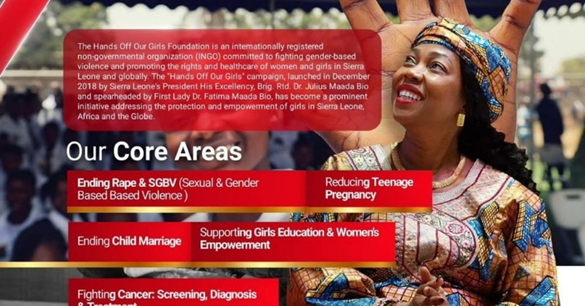
Central to the feature is Dr. Bio’s flagship initiative, the Hands Off Our Girls campaign, which the magazine describes as one of the most impactful movements against sexual and gender-based violence in Sierra Leone’s recent history. Launched to confront rape, child marriage, and abuse, the campaign has played a critical role in shaping progressive legislation, strengthening institutional responses, and increasing public awareness around the rights of girls.
Through this campaign, Dr. Bio has championed policies that promote girls’ education, improve access to healthcare, and accelerate justice for survivors of sexual violence. The magazine notes that these interventions have contributed to national conversations that were once considered taboo, forcing accountability and driving reforms in a society long plagued by silence around gender-based crimes.
In addition to her national advocacy, Dr. Bio’s international influence is underscored by her role as a UNAIDS Champion, where she has been instrumental in advancing awareness and policy responses related to HIV/AIDS, particularly among women and adolescent girls. Her work in this area, the magazine reports, reflects her broader commitment to addressing the structural inequalities that expose women and girls to health and social vulnerabilities.
The feature also traces Dr. Bio’s journey from the creative arts to global advocacy. Before assuming public office, she built a successful career in the film industry, earning multiple accolades, including Best Actress for her role in the internationally acclaimed film Mirror Boy. Women in Leadership Magazine credits this background with shaping her communication skills, empathy, and ability to connect powerfully with diverse audiences—qualities that now define her advocacy work.
What distinguishes Dr. Bio’s leadership, the publication notes, is her emphasis on inclusive development. As President of OAFLAD, she has worked closely with fellow African First Ladies to harmonize strategies on education, health, women’s economic empowerment, and child protection across the continent. Her leadership within OAFLAD has helped reposition the organization as a strategic force influencing continental and global development agendas.
The 27th edition of Women in Leadership Magazine ultimately presents Dr. Fatima Maada Bio as a transformative figure whose influence extends far beyond the traditional expectations of a First Lady. It describes her as a leader who has redefined the role into one of action, accountability, and moral courage—using her platform to confront injustice and advocate for those most at risk.
As her global profile continues to rise, the magazine affirms that Dr. Bio’s work stands as a testament to the power of principled leadership rooted in service. Her story, it concludes, is not only one of personal achievement, but of enduring impact—reshaping laws, changing mindsets, and advancing the rights and dignity of women and girls across Africa and beyond.